 .......
......
.......
............. .........................
The
International Occultation Timing Association's 43rd Annual
Meeting
September 6 -7,
2025 via Zoom online
Richard Nugent, IOTA's Executive Secretary
Special thanks to Dr. Joan Dunham and Dr. Roger Venable for their technical operation of the Zoom meeting
..............
.............
.........................
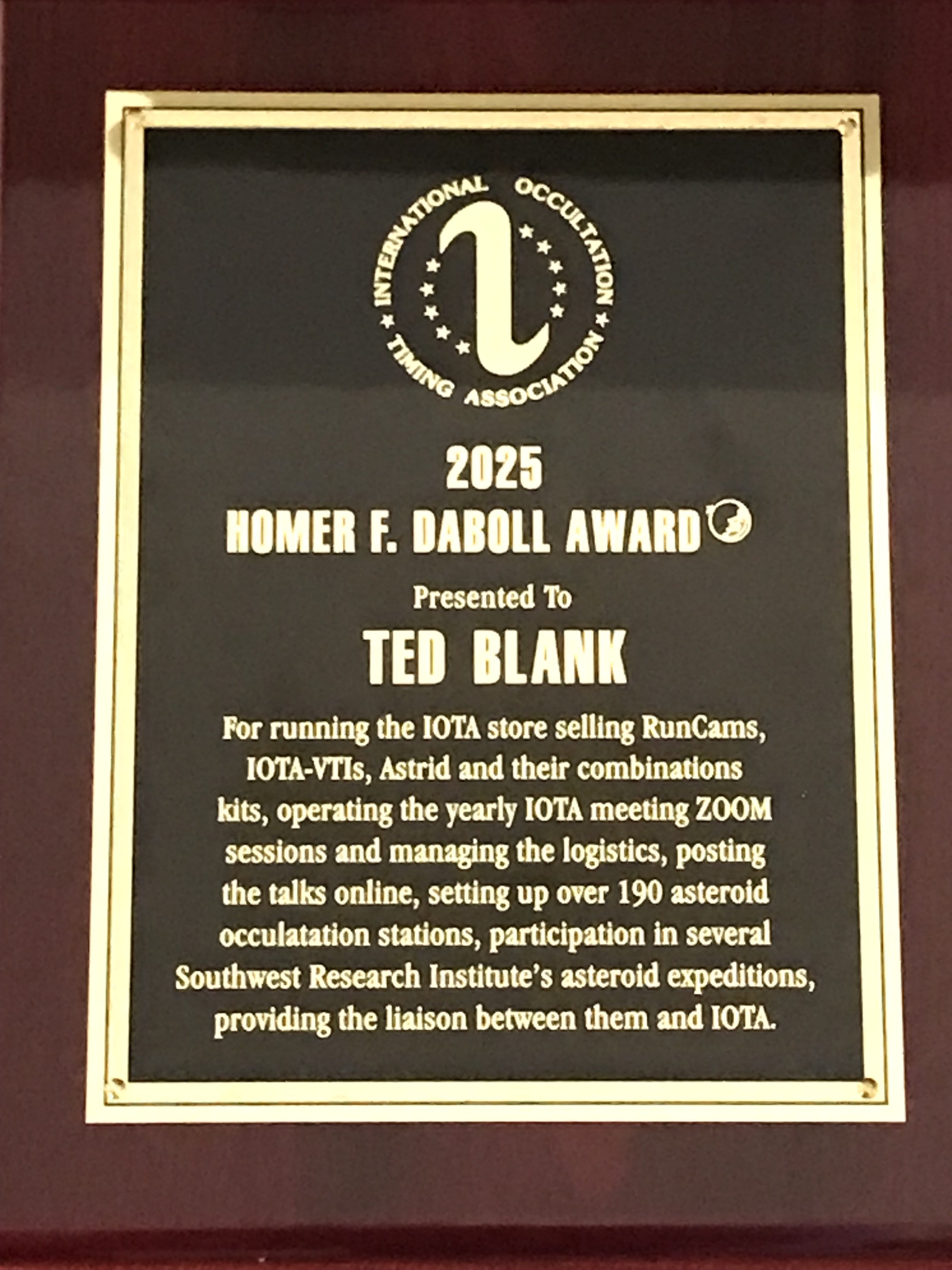
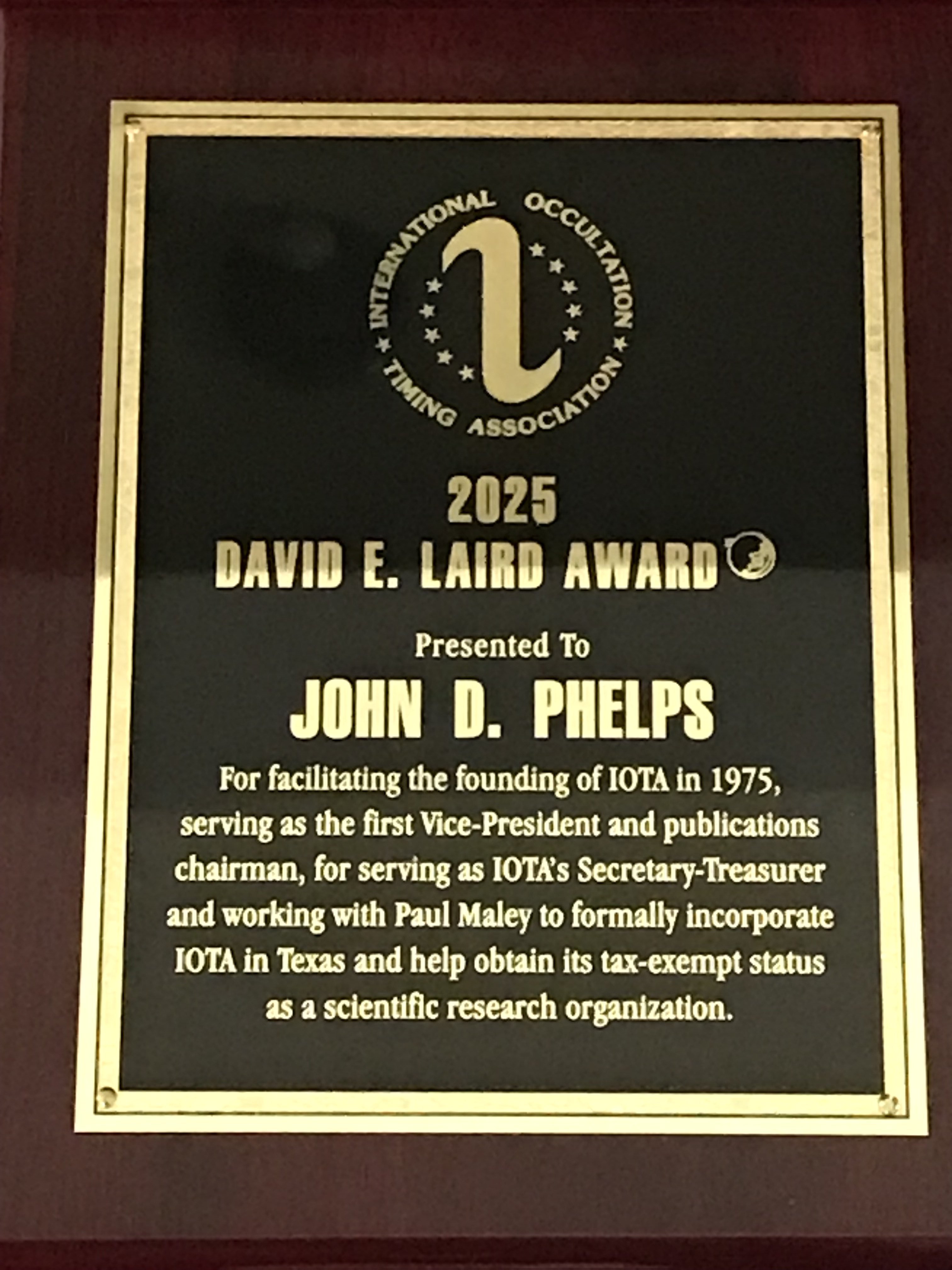
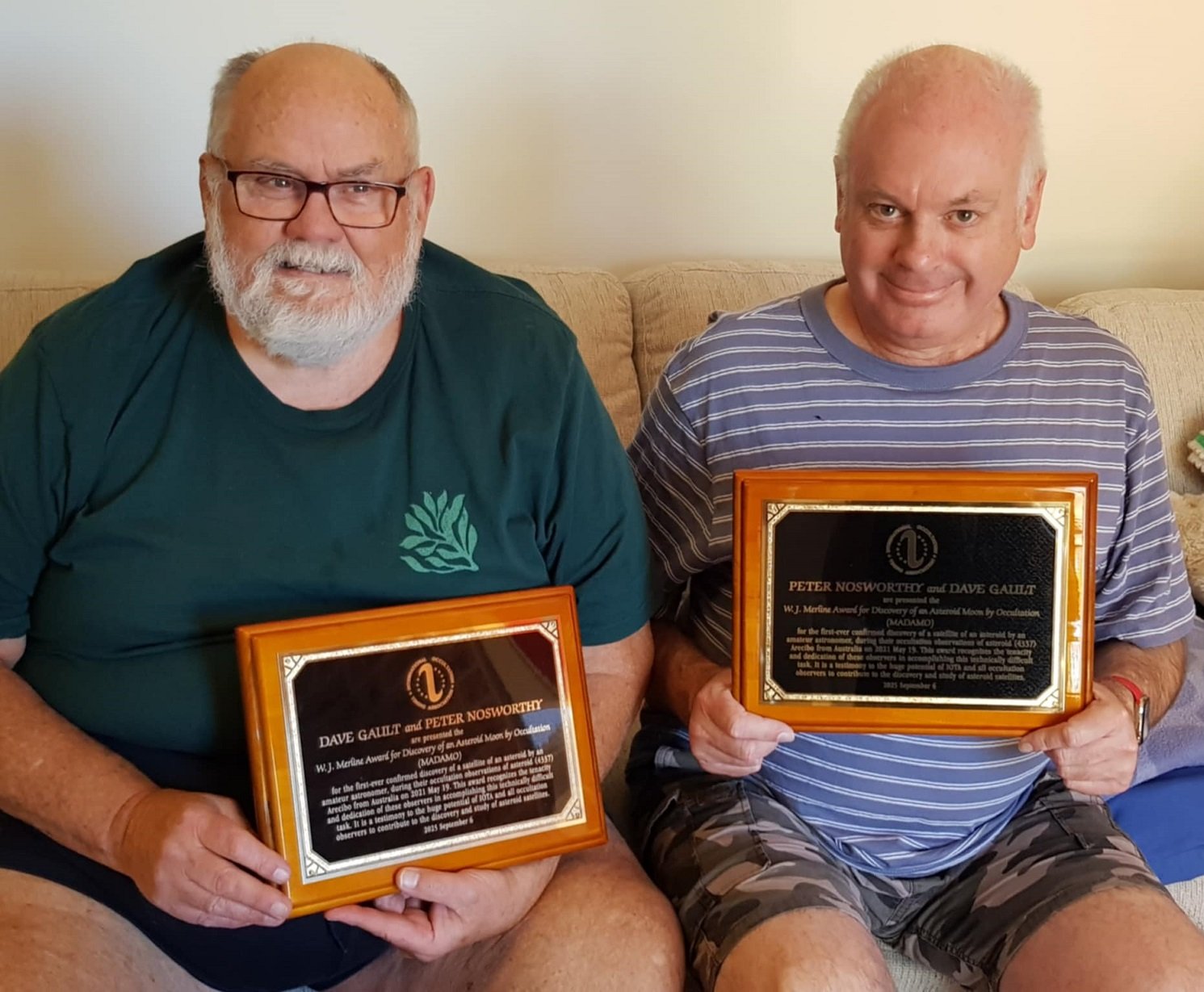
....Homer F. Daboll Award winner: Ted Blank ................David E. Laird Award recipient: John D. Phelps ..................Dave Gault and Peter Nosworthy, MADAMO award recipients for the ...............................................................................................................................................................................................first ever discovery of an asteroid satellite by occultation - 4337 Arecibo
SATURDAY, September 7th 20:00 UT – Meeting
start
Vice President Dr. Roger Venable welcomed
everyone to the meeting. Attendees: The meeting started with a
total of 47 participants, rose to 57 and this number fluctuated
throughout the session.
Business meeting:
Treasurer Dr. Joan Dunham presented IOTA’s
financials and membership status. A summary of the year’s
income/expense report through August 1, 2025:
Income:
Membership dues & donations.....$77,120
Sales, IOTA Store.........................$10,546
Total Revenue.............................$102,764
Expenses:
Legal and Accounting..............$2,945
Internet........................................$290
Insurance..................................$2,249
JOA..........................................$1,133
Shipping, postage.......................$851
Software & apps.........................$271
PayPal fees.................................$102
Total Expenses.........................$7,841
Net Revenue..........................$94,923
Net Assets:
Bank accounts......................$296,055
IOTA PayPal............................$2,898
PayPal Store.............................$9,127
Investments..........................$782,665
TOTAL..............................$1,090,745
Special Purpose Funds:
MADAMO Award*.................$4,000
*W. J. Merline Award for Discovery of an Asteroid Moon by
Occultation (MADAMO). This cash award will be sent to Dave Gault
and Peter Nosworthy this week.
IOTA Membership and Subscription: Voting Membership - 125
Donations to IOTA have been made by:
Derald Nye Trust
The family of Walter Morgan, contributing via the Rausch
Charitable Fund
Berton Stevens
Anonymous donors via PayPal Giving Fund
Non-cash donations were made by many, spending many hours on
observing activities, data analysis, software development and
maintenance, IOTA administration, outreach activities, web site
maintenance, and more. To everyone who donated to IOTA this past
year: THANK YOU! Your support is key to IOTA’s success!
Joan reported the activity with the IOTA store run by Ted Blank.
The inventory as of August 25, 2025 is:
17 RunCam Night Eagle 3 cameras with Power/data cables
5 V3 Analog VTI Time Inserters (recent donations)
2 “Open VTI” Analog Time Inserters
10 Complete ASTRID kits ready to assemble minus timing boards (on
order)
44 InnoMaker custom cameras for ASTRID
Items currently on order: 10 ASTRID timing boards (for any of the
3 models, Refractor, Prime or Dob) and
10 Night Owl 0.5X Focal Reducers
Sales since August 2024:
30 Complete ASTRID units (mix of Refractor, Prime and Dob)
8 “Open VTI” Analog Time Inserters
2 V3 IOTA VTI Analog Time Inserters
Future plans for the IOTA store include:
- Continue to build, test and ship ASTRID devices
- Continue to build, test and ship analog “Open VTI” if
there is demand
- Continue to build, test and ship “Analog Occultation
Kits” using RunCam and “Open VTI” if there is
demand
- Build, test and ship “IOTA Flash Timer” when
available
Ted will be going to India September 9, 2025 bringing 2 suitcases
of equipment. The IOTA-India section has limited access to
occultation recording hardware to expand their reach to schools
and universities.
Executive Secretary Richard Nugent presented the
results of the 2025 election. IOTA’s revised its By-laws in
2022. The new By-laws stated that IOTA Officers will be chosen by
Board members. Board members (minimum of 3 and up to 9) are to be
elected by the general paid membership.
The election results were unanimous for the following persons:
Elected in 2024 (in a special election):
Board Member: Dr. Aart Olsen
Board Member: Dr. Greg Lyzenga
Elected/re-elected in 2025:
Executive Secretary: Dr. Greg Lysenga
V.P. for Grazing Occultation Services: Dr. Mitsuru Soma
V.P. for Lunar Occultation Services: Walt "Rob"
Robinson
V.P. for Planetary Occultation Services: Norm Carlson
Board Member: Dr. Michael Skrutskie
Richard Nugent next presented IOTA’s Homer
F. Daboll and David E. Laird awards. The Homer F. DaBoll Award is
given to recognize significant contributions to the field of
occultation science and to the work of IOTA. This year's
recipient of the Homer F. Daboll award is Ted Blank.
Since 2010, Ted set up over 190 stations, many of them multiple
stations. Ted runs and operates the IOTA Store, assembling kits
for the RunCam cameras,the IOTA VTI and Astrid camera. He has
participated in several SwRI expeditions for the KBO 2014 MU69
occultation, (discovered by Marc Buie)including Cape Town,
Columbia, Argentina and Darwin, Australia. The SwRi expeditions
obtained valuable data for these special occultations as well as
providing good liaison between them and IOTA.
Upon notification of the award, Ted sent the following email:
I am very humbled and honored to receive this award from my
colleagues here in IOTA, and very sorry I cannot be with you
today. Chasing shadows has been a source of great enjoyment
for me since meeting David and Joan Dunham at the Cambridge,
Mass. IOTA meeting in (I think) 2010. Occultation recording
is an accessible way for an amateur astronomer to make a
significant contribution to Solar System science. While
variable star observing is another interesting and useful
approach, some of us enjoy the "chase" as well.
As a software guy I have to especially thank Tony George for
patiently teaching me how to use LiMovie, R-OTE and
PyOTE/PyMOVIE, along with the developers of those packages and
all the rest of the wonderful software we depend upon. Clear
skies everyone!
-Ted
The David E. Laird award is given to recognize those
who, more than 15 years ago, made significant contributions to
occultation science and to the work of the IOTA. This year’s
David E. Laird award recipient is John Phelps, Jr.
from Orland Park, Illinois. John Phelps helped create IOTA in
1975, serving as the first Vice President and Publications
Chairman for IOTA for three years. For another five years, until
1983, he served as IOTA’s Secretary-Treasurer, assuming the
important role as the point of contact for IOTA. In 1983, he
worked with Paul Maley to formally incorporate IOTA in Texas and
apply for tax-exempt status as a scientific research
organization. John helped set up IOTA’s current structure
still in use today.
Upon notification of the award, John sent the following email:
Hi Richard,
Your phone call was sure a bolt from the past! I occasionally
still think about my time chasing grazes. PBS recently had a
program about an asteroid graze viewed from, I believe, the
MiddleEast or Africa. Unfortunately, my computer died shortly
after I received your message. I did find a picture of Homer. It
is not to recent since it is from the 1970 eclipse. This was my
first total eclipse which I had been looking forward to since I
discovered the Canon of Solar Eclipses in 1963. I came home on
leave from the Navy and my Mother met me in Norfolk. We drove
down to North Carolina where we met up with Homer Daboll and his
wife Audrey. The next day, we went to a carefully preselected
site nearby to watch the eclipse. Homer was participating in an
observation program to measure motion of the corona using photos
taken at a string sites along the eclipse track thru special film
that had a broad range of sensitivity using a surplus aerial
camera lens mounted on an wood frame equatorial mount. I tried to
photograph, not to well, thru a homebuilt 3-inch reflector while
watching visually thru a small elbow telescope. My Mother
photographed, on slide film, the activity and changing light
levels using a simple Instamatic camera. She got one of Homer
standing near his rig and facing the camera near the beginning of
the partial phase leading up to totality. If you are interested,
I can try to get a print made from the slide and mail it to you.
Insidently, last year I completed what I call a Grand Saros, By
observing the April 17th eclipse in southern Indiana.
John
======================
Technical sessions: 16:25 UT
Paul Maley discussed the history and motivation
of the W.J. Merline Asteroid Satellite Award (MADAMO) which was
introduced in 2013. Paul discussed his history with IOTA starting
in 1969 when he began organizing grazes. The catalyst for the
MADAMO award was his personal visual observation of a possible
satellite of 6 Hebe in 1977 which unfortunately has yet to be
confirmed. Paul then talked more of his occultation history and
observations worldwide and recently in the Arizona area. Paul has
made an astounding 963 positive observations to date of asteroid
occultations in his 50+ year career.
Dr. Bill Merline, retired staff scientist from
the Southwest Research Institute, discussed the MADAMO award and
its creation by Paul Maley. It is a $4,000 cash award to the
first amateur (not professional) astronomer that discovers an
asteroid satellite by the occultation method. Specifically the
award requirements are:
1. Award is open only to an amateur astronomer, i.e., a person
who is not and has never been employed as an astronomer in whole
or in part by any institution prior to or at the time of the
discovery.
2. To be eligible, membership in IOTA or one of its affiliated
organizations (such as IOTA/ES or IOTA/ME) is required for at
least 2 years prior to reporting a possible asteroid satellite
discovery; the award is open to individuals from any nation.
3. Award can be shared by more than one individual on the
occasion of multiple individuals providing credible evidence of
the same satellite during the same occultation event.
4. Method of detection must be using IOTA methodology such that
the resultant video record can be analyzed with IOTA software
tools. The term “IOTA methodology” means data collected
through single or multi-station observations using GPS
time-inserted video, with fixed or mobile optics.
5. Observers using equipment loaned by IOTA or receiving partial
funding support through or authorized by IOTA are eligible.
Anyone receiving financial support not authorized by IOTA or
using equipment provided by other entities is not eligible.
6. Donors are ineligible to receive the award.
7. Does not apply to re-detection/rediscovery of satellites
already found and formally identified.
Bill then showed the qualification steps which included reporting
the discovery to IAU, plus confirmation and validation by
independenat methods (not by occultation) and teams. He then
showed the light curves from the 4337 Arecibo occultation on 2021
March 19 made by Dave Gault and Peter Nosworthy from Australia.
Just 3 weeks later, observers Drs. Richard Nolthenius and Kirk
Bender also detected Arecibo's possible satellite from an
occultation in California, again from light curves.
An independent team, led by Paolo Tanga (Université Côte
d’Azur), allowed decisive confirmation to be made by using
astrometric data from the Gaia mission. Their independent
analysis of the asteroid’s duplicity, using a combination of
Gaia data and the prior occultation data, allowed a preliminary
orbit determination and indicated that the occultation detections
were of the same object tracked by Gaia. The results are
published by Tanga et al. in Astronomy & Astrophysics 674,
A12 (2023). A 3rd independent team (required for the award)
validated these results using extensive additional Gaia data and
improved the orbit. Paper reference: Liu (IMCCE, Paris
Observatory, CNRS) et al., Astronomy & Astrophysics 688, L23
(2024).
The corroborating observations by Noltenius and Bender plus the
Gaia data analysis clinched and confirmed the discovery of
Arecibo's satellite to Gault and Nosworthy. The impact of the
this discovery demostratess that occultations can play a pivitol
role in asteroid science.
Bill mentioned his background in building and testing instruments
for searching for exoplanets in his Doctoral work and how it
eventually led him to look for companions of asteroids. Bill was
on one of the imaging teams for the Galileo discovery of the
satellite of 243 Ida named Dactyl. He then talked about the
history he had using some of the largest telescopes in the world
in searching for asteroid satellites including getting 16 half
nights on the Hawaii Keck telescopes looking at Pluto's moons.
Full Details of the MADAMO award and it's requirements are found
at https://pauldmaley.com/merline/
Dr. Ted Swift presented his experience in May
2025 of discovering that (33956) 2000 NN3 may have a moon. He
outlined his mobile observation planning, the observation itself,
the discovery of a suspected moon during video analysis, the
careful confirmation steps taken, and the CBET publishing
process. He also discussed some of the resources available to
everyone to learn more about binary asteroids, and the scientific
usefulness of observing binary asteroids. From analysis of his
light curves, the presumed size of the satellite was estimated to
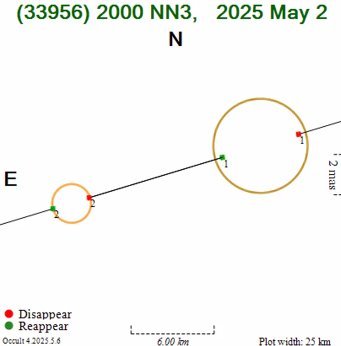
be 2.8km. He showed the sky plane plot of the asteroid and
suspected moon. It was estimated that the separation of the
objects to be about 14.3km and this was likely a lower limit
since only one chord was obtained. The skyplane plot of the
system is shown below.
.............................................................................................
Jean-Francois Gout (Jeff) discussed using
photometrty on asteroids. Photometry can determine the rotation
period of asteroids from light curves. Typical rotation periods
of asteroids are 2-20 hours and this usually requires
observations over several nights. Light curves can also infer the
shape of asteroids and to date there are over 10,000 shape models
determined. Jeff then showed light curves of binary asteroids and
how they differ from single object light curves. Binary asteroids
typically show a rapid short secondary drop in brightness due to
the typical small size of the satellites. He mentioned the TESS
satellite and the 100's of asteroid photometry data sets in its
archives. He showed a table of binary asteroid discoveries
todate. Photometeic light curves lead the way in such
discoveries. Photometry has discovered several binary asteroids
in recent years and it can be used as a follow up to help
determine the physical parameters of these systems. Parameters
such as orbital period, mass, separation and size of the
components. He showed the asteroid occultation coming up on Sep
10, 2025 of 33476 Gilanareiss over the USA and that this
asteroid's photometery shows a possible satellite.
Dr. Ted Swift commented that knowing the orbital parameters of
binary systems and their masses could lead to densities of these
asteroids.
Vice President for Planetary Occultation Services Norm
Carlson discussed some of the interesting asteroid
events of 2024-2025. For 2025 he projected that there will be
1140 North American events observed. This is slightly down from
2024. Norm also discussed the status of the review process of
events and how reports and skyplane plots are uploaded to the
North American asteroid website.
Norm next talked about the review process for North American
asteroid Occultations. Observers send in their log, report file,
CSV file and light curves. Then all files are sent out to a
reviewer. First the report form is reviewed. Reviewers have seen
errors in just about every report filed. Reviewers process the
CSV files typically with PyMovie to compare with the
observer’s results. The Coordinator then sends the results
and light curves to Dave Herald and Dave Gault for final review
and eventual uploading to the MPC. Light curves are sent to the
ViZier database.
The North American review team is looking at a more automated
system, like SODIS. Currently the review team consists of 13
people: Jerry Bardecker, Johnny Barton, Steve Conard, Bob
Dunford, Joan Dunham, Kevin Green, Ernie Iverson, Robert Jones,
Steve Messner, John Moore "Coordinator Emeritus,"
George Viscome, Dave Eisfeldt-Tangra support, Tony George-
difficult observations. Dave Gault and Dave Herald make the final
reviews.
Norm is working on getting a training coordinator to for new
reviewers. The review team needs more help. Contact Norm at reports@asteroidoccultation.com. Norm showed sky plane plots of a satellite discovery
for 3927 Feliciaplatt on 22 December 2024 by Vince Sempronio. A
confirmation just 10 days later on Jan 1 2025 was made by Roger
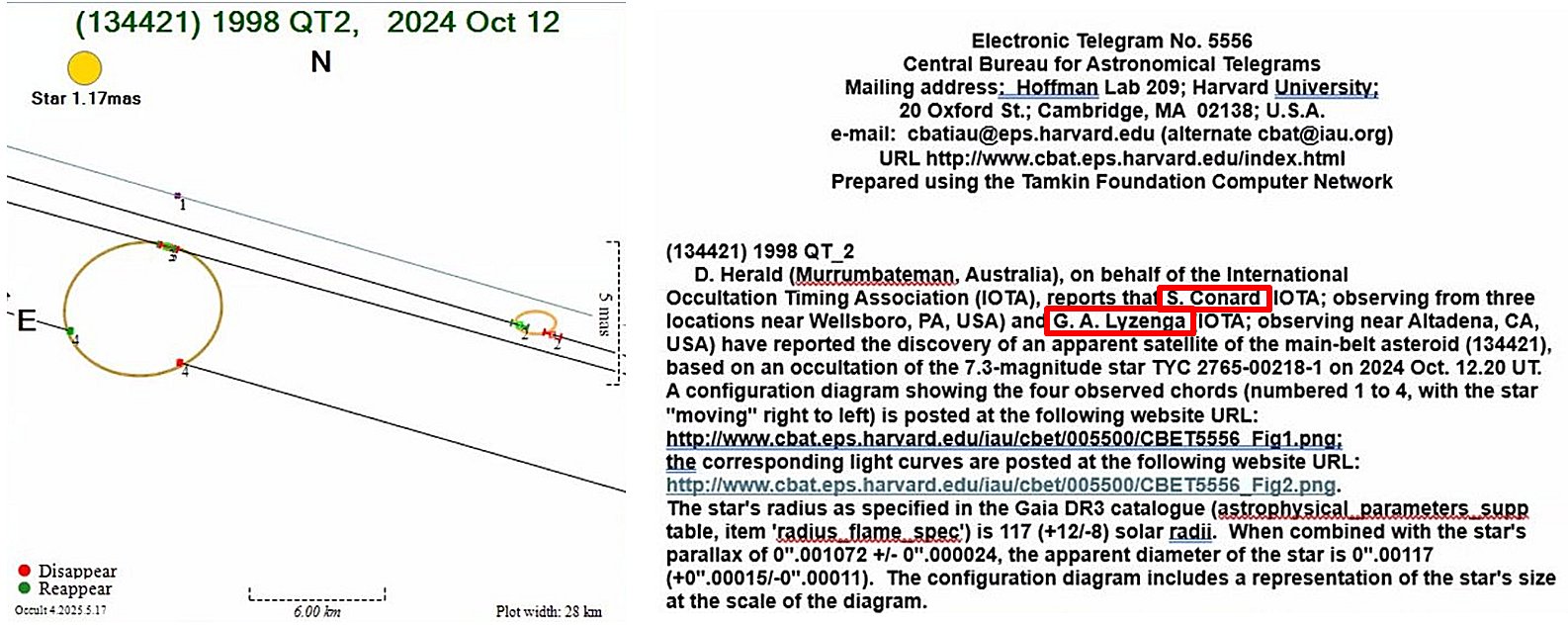
Venable and Kai Getrost. Another satellite discovery by Steve
Conard and Greg Lysenga with multiple stations 132221 1998 QT2
was made on 2024 Oct 12.
........................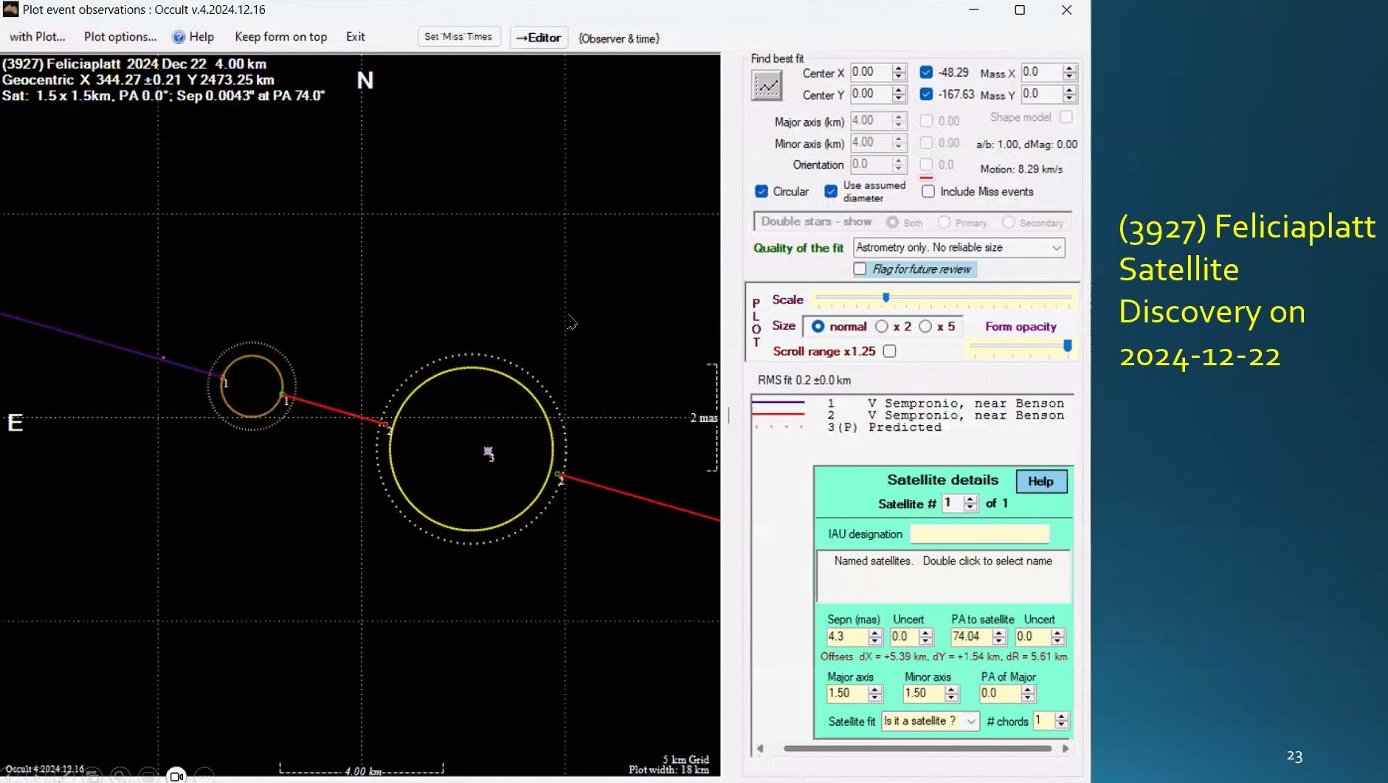 ................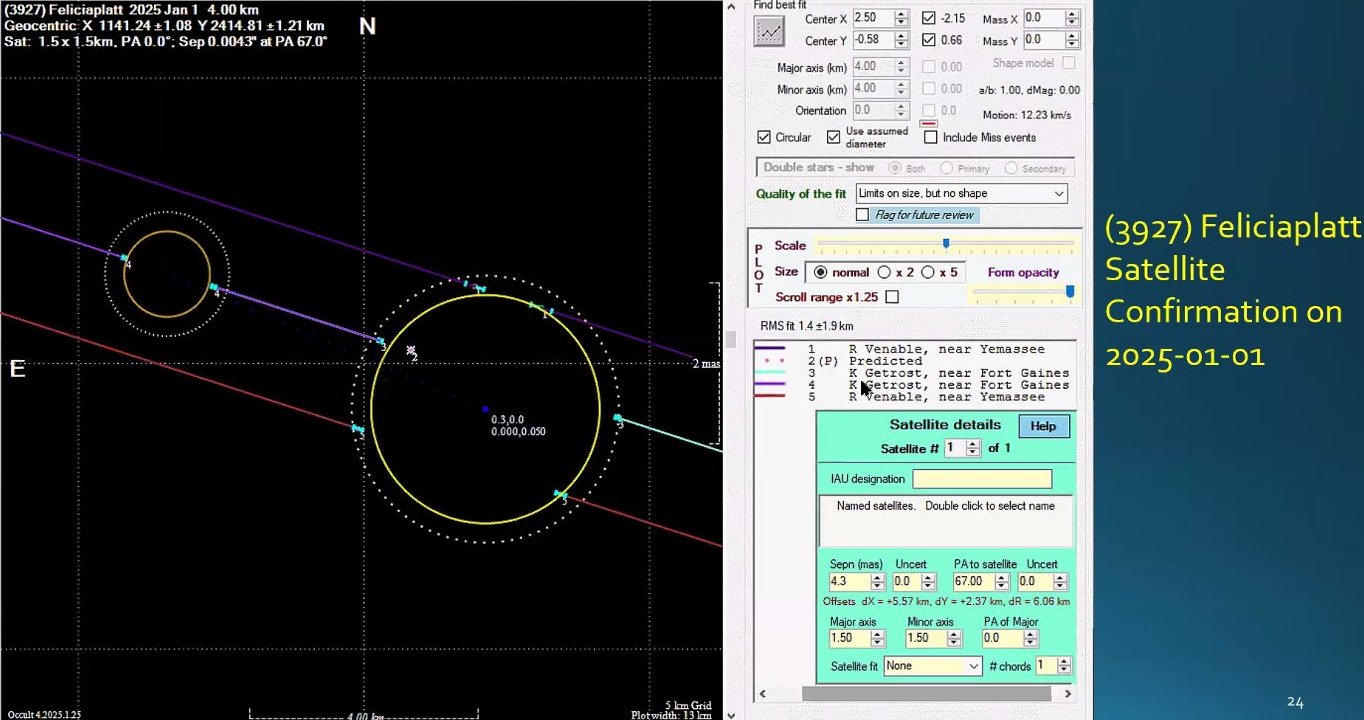
....Left: Apparent satellite dicovery of 3927 Feliciaplatt by Vince Sempronio. Right: Confirmation 10 days later by Roger Venable and Kai Getrost
......
Another satellite discovery by Steve Conard and Greg Lysenga with multiple stations 132221 1998 QT2 was made on 2024 Oct 12 shown below:
.................................
..............................
Hristo Pavlov then talked about recent
updates to Occult-Watcher (OW) software and how to use it. Hristo
authored OW 15 years ago and the latest version is OW 5.5. OW
allows observers to coordinate online with each other for
multiple chord events by announcing their planned location to
avoid duplication. Hristo's talk was a live demonstration of OW's
new features he has implemented. A few of new updates are:
1. The estimated asteroid shadow (size) across the bottom of the
screen so observers know where on the ground the asteroid shadow
will pass. Asteroid sizes and shapes vary, Hristo plans to list
the errors in the size in future OW updates
2. Cloud prediction (% of cloud cover) and weather conditions for
locations
3. Announcing your observation after the event has passed. For
those doing these after the fact events, you must file and list
your report: miss or positive.
4. When choosing an event, OW will list how many previous events
for that asteroid have been observed.
5. OW 5.5 is faster
Kazuhisa Miyashita next talked about a data
collection system for asteroid occultation reporting currently
being used/tested in Japan. For a long time, Japan observers sent
in their observations and reports by email which made it
difficult for the coordinator as there was no set format for
reporting. He showed the Reconstruction of Observation Reports
via EMail Text (ROREM) and how it was the 2nd step toward
efficiency. Previous reports were done by email and had common
mistakes such as precise location. The coordinator had to
manually decifer the data and finalize for submission to the
world coordinator. He also showed how the data recieved allowed
prediction of diffraction patterns on light curves.
Observers create their reports by clicking on a button
"Make Report" from the Limovie light curve. This
creates a file that includes the D and R times of the event along
with the uncertainties and S/N ratio. The observer's name, GPS
coordinates, telescope, aperture and time keeping method are
entered. See the Report making function below.
......................................................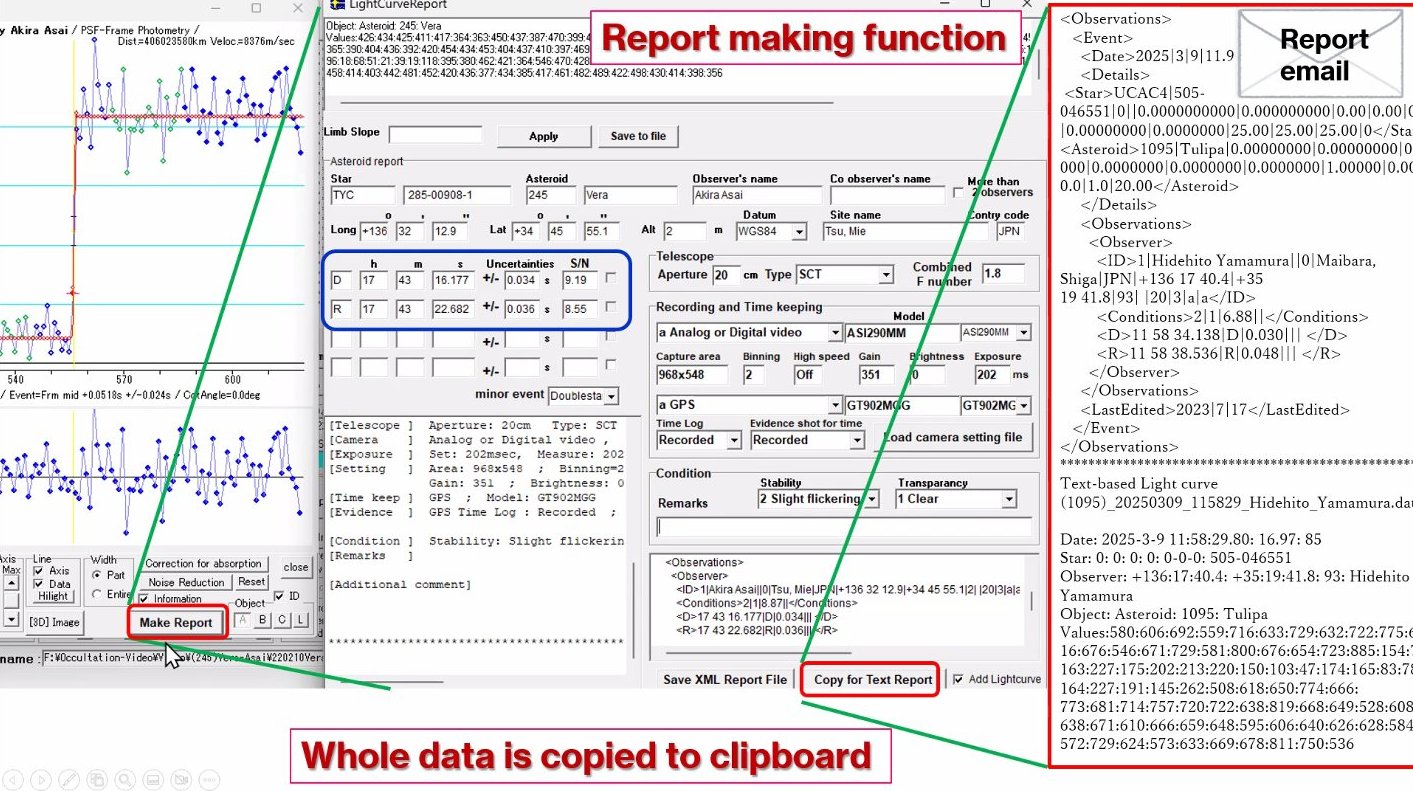
By clicking on "Make Report", ROREM makes a
file which includes observer information and D and R times. A
report email is generated from this data The observer then
selects "Copy for Test Report" and this creates the
details of the event ready to email to the coordinator. The new
collction sytem ROREM does the following:
1. Provides a system that collects the report emails with minimal
effort
2. Transcribes the email report to OBS.XML files automatically
3. Collected files from the observation: camera setting, GPSD
log, light curve CSV, light curve graph image,
4. ROREM stores the various data and makes it available to
anyone. It makes an HTML file from the database automatically and
creates the webpage with the following information: Date/Time of
event, Asteroid name/#, observer, result (plot), light curve
analysis, star mag, predicted mag drop, telescope used, camera
and settings, video format (AVI), Time and GPS location and O-C
differences.
5. Makes and sends the regional report to the IOTA Center
automatically and this includes: OBS.XML files for each event,
.dat light curve files for each observation
The coordinator can combine multiuple observations into a single
XML file for reduction using Occult4. The ROREM collection system
allows monthly reports and is made automatically.
Kazuhisa mentioned the asteroid Apophis is an additional flyby
target of the Japan/German Destiny mission scheduled to be
launched in 2028. Some 60 opportunities are availble for
occultation events of Apophis with 7 visible from Japan.
Steve Messner talked about the North American
low magnitude feed that he maintains (NA Low Mag Feed). Steve
started out with an 18" newtonian scope and began using
Occult to search for fainter events than were posted on Steve
Preston's asteroid page. He thus created the NA feed for these
fainter events. Now, with Gaia data, the feed has had much better
predicitons. He now has been listing several hundred
events/month. Starting in September 2025, he'll change the search
criteria for these faint events as follows:
1. List events to m = 14.6, with >1 second duration with
>0.6 mag drop
3. As faint as 13.6, >0.7 sec duration with >0.4 mag drop
4. As faint as 12.6, > 0.5 sec duration, > 0.4 mag drop
5. As faint as 11.6, > 0.4 sec duration, > 0.5 mag drop
Starting in November 2025, he'll add events as faint as 11th mag,
with > 0.3 sec duration
December 2025: he'll list events down to 15th mag stars.
And all events listed will have a solar elongation > 25 deg.
Steve mentioned he can change the filters for events especially
avoiding those with short durations and a low rank.
The meeting ended at 23:20 UT.
===================================
Sunday, September 7, 2025, 20:00UT. Technical sessions continued.
Dr. Roger Venable called the meeting to start. Initially
there were 26 attendees and this figure rose to 57 quickly and
fluctauted throughout the meeting.
Dr. David Dunham presented a talk about the most
important and special asteroid occultation events for the the
remainder of 2025 and the coming year 2026, particularly special
main belt objects, NEAs, Trojans to support the Lucy mission
(RECON campaigns), new asteroid moon discoveries and 2026 Lunar
grazing events. Many events are on David's webpage:
https://occultations.org/publications/rasc/2025/nam25MBoccs.htm
David mentioned the sucessful 2025 April 18 occultation in
Missouri by 319 Leona. This event increased the knowledge of the
size and shape of Leona. This will help with the 2023 December 12
Betelguese occultation analysis. Another event was the
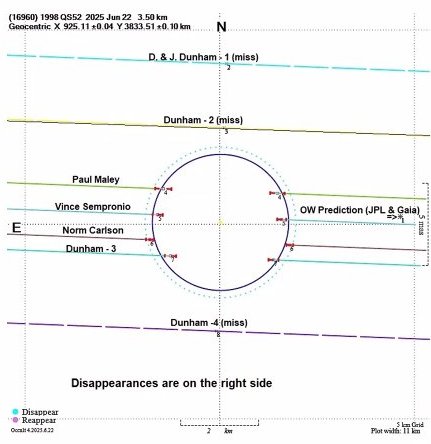
potentially hazardous 3.5km size asteroid (PHA) 16960 1998 QS52
which occulted the 9.9mag star PPM 203111 on 2025 June 22 across
the south USA. This is one of the larger PHA's whose impact would
result in wordlwide devastation, however there's no risk in the
next 1,000 years. This asteroid 16960 1998 QS52 sky plane profile
is shown below:
.................................................................................
More occultations David showed with their paths:
2025 Bright Occultations for the RASC Observer’s Handbook
2025 NEA Occultations
2025 Special Main Belt Asteroidal Occultations
2025 Trojan Occultations including Menoetius on 15 Nov 2025
2026 Lunar Grazing Occultations including Regulus on 2026 Feb 5
David finished with RASC Observer’s Handbook lists of lunar
grazing occultations for 2025. He showed path maps and
dates/times for the events.
Jean Francis Pillet next talked about several
scripts for Sharpcap Pro to help prepare and observe an event.
Sharpcap does not have star catalogues, rather they are from
SharpSolve and can be shown by the Deep Sky Animation tool. For
UCAC4 stars, the script shows the stars on the live view
following a plate solve. The SharpCap script uses an external
C-compiled software for the star search from the UCAC4 catalog.
Jean showed real time views of how this script works.
Script 2 is for QHY174-GPS LED camera calibration. Manual LED
calibration can be tedious and has to be repeated after changing
settings such as exposure, USB trsaffic, ROI height and cameras
color space. Jean showed how this script simplifies the
calibrations of these cameras. Scripts can be downloaded from the
forum SharpCap: https://forums.sharpcap.co.uk/viewtopic.php?t=8492
Script 3 - For occultations and preparation with Occult
Watcher Addin. For use with OW, select an event and generate an
observation file with the Addin. Jean then demonstrated this
procedure and how to use it with GOTO telescopes: Target images
can be captured automatically or manually. The script allows
setting up an observation hours in advance (assuming a good polar
alignment) to start and stop the recording of an occultation.
Following the capture, saved information is the start/end time of
the observation, exposure time and even weather conditions. Jean
showed an example event he observed using the scripts for 468861
2013LU28 observed on 2025 January 30.
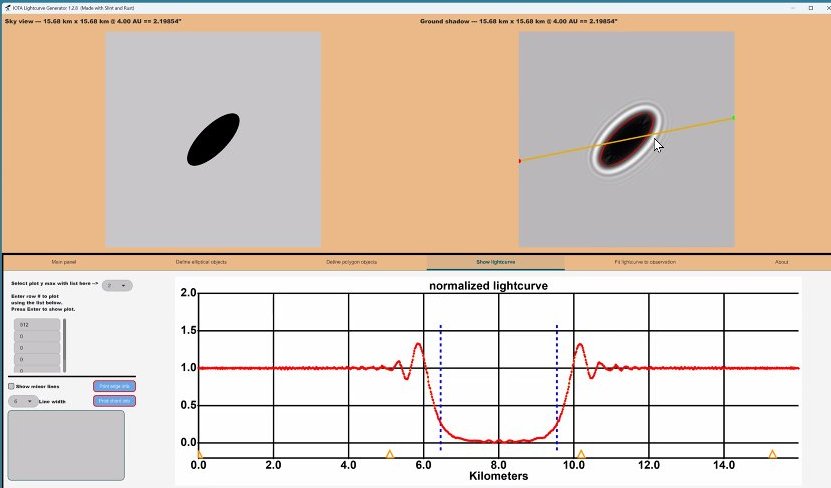
Bob Anderson presented a new analysis software
for Fresnel difraction fitting for light curves. This new tool is
a joint project with Dave Herald currently being developed. He
programmed it with Slint. Slint is an open-source, declarative
graphical user interface (GUI) toolkit primarily written in Rust.
It allows the user to draw the asteroid and light curve to
generate a shadow of the sky plane view. The shadow light curve
includes: fresnel diffraction (always present), graze angle, star
diameter, magnitude drop, camera exposure and asteroid shadow
speed. Bob demonstrated how the program works using a point
source star and a small asteroid. Bob showed several examples: An
observation path in the center of the asteroid shadow showing
Fresnel diffraction showing nearly equal vertical height on both
sides of the light curve (shown below), a graze situation with
the resultant light curve, and the light curve with a finite size
star.
....................................................................
Dave Herald continued the presentation
with this new software showing several example light curves from
real observations. Using this tool requires some experimentation
with the shadow/asteroid size parameters for fitting to light
curves. Dave demonstrated the rather tedious process of filling
out the form for creating the shadow and matching the light
curve. This was from 2 chords for the asteroid 9203 Myrtus and
its satellite from an observation on 2025 Feb 22 from Japan. Dave
is curently writing documentation for this program.
Dave next talked about double star occultations. This talk was
dedicated to Brian and Pauline Loader, both who have very
recently passed. Historically, Brian Loader handled double star
discoveries from both lunar and asteroid occultations. Double
star discoveries from occultations are usually published in the
Journal of Double Star Observations (JDSO). There were 3 double
star discoveries in 2010. By 2024, there were 23 discoveries, and
in 2025 to date 17 discoveries. In 2025 thru July there have been
26 single-component discoveries. In order for double star
discoveries to be included in the published Washington Double
Star Catalog (WDS), Brian Mason of the USNO needs at least a
minimum separation. For inclusion in the WDS, the double star
discovery must be published in a journal, preferably the JDSO
which is one of several journals monitered by the USNO.
A recent single component observation has been matched to a known
double star component. This observation of Tyc2 2453-01773-1 was
made by Steve Messner on 2024 Feb 21 with the separation
determined as > 3.3 mas. From the separation history of this
double star, a question arises: Is the orbit of this system
highly eccentric? The separation has varied from 0.522" in
1982 to 0.070" in 1994 to 0.276 in 2008. Such varying
separations could mean a nearly edge-on viewed orbit of a binary
star (position angles staying constant) or a highly eccentric
orbit viewed face on.
Dave showed a light curve of a recent observation currently being
investigated which apaears to be a discovery of a triple star.
Dave then presented the best observed world wide asteroid
occultations since last year. Dave showed the number of events by
asteroid size and chords from the various IOTA regions. Europe
and N. America have the most observations approaching 1,000 for
each region. The numbers show that 77% of all observations are
single chord events. For 2024:
Single chord events: 2032
2-3 chords: 496
4-9 chords: 79 chords
10+ chords: 4 events
The total # of events simce 2000 from all regions = 13,889. The
huge increase of observed events recently is largely due to
Gaia's accurate positions of asteroids which in turn allows
highly accurate updated orbits.
Satellite discoveries are on the rise also. In 2024: 3
discoveries, 2025 (to date): 7 discoveries and pending: 4
discoveries.
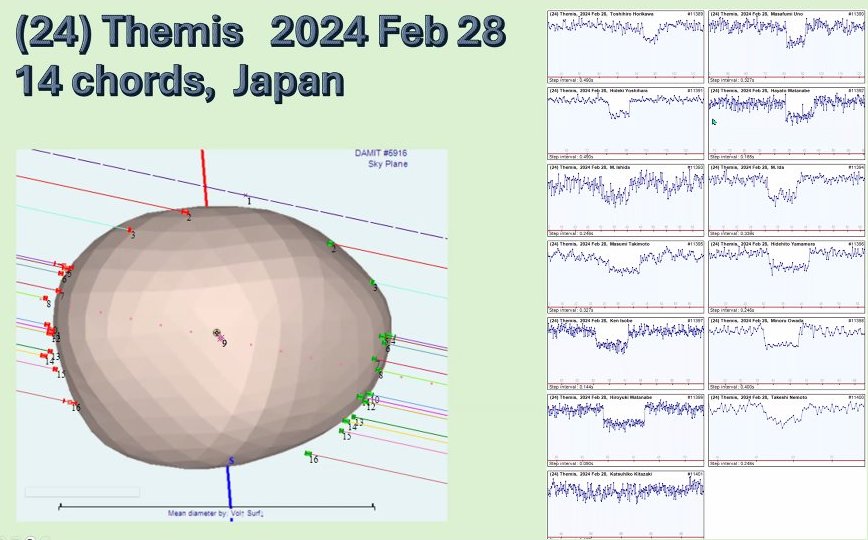
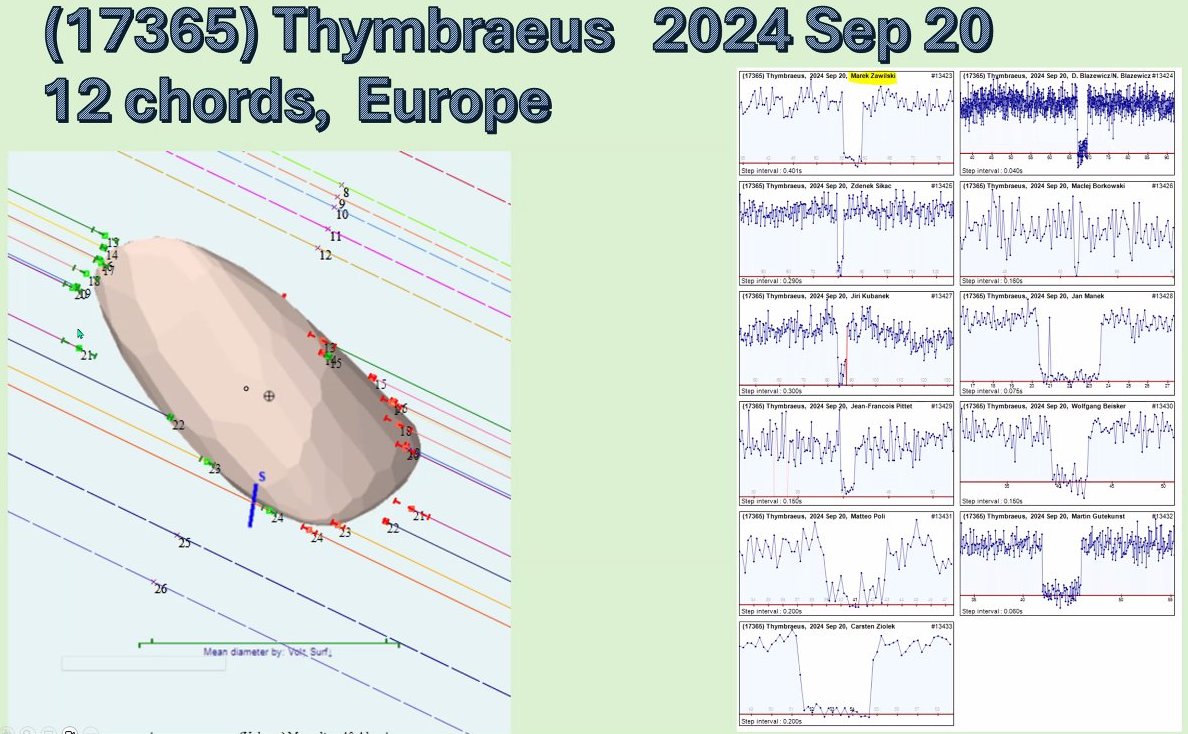
Dave showed several selected events from 2024 with multi-chords:
24 Themis: 2024 Feb 28, 14 chords, Japan, shown below
16583 Oersted: 2024 MAr 3, 14 chords, Europe
781 Kartvelia, 2024 MAr 10, 9 chords, Japan
1574 Meyer 2024 Aug 10, 13 chords, Europe
17365 Thymbraeus 2024 Sep 20, 12 chords, Europe, shown below
................ ..................
Several questions were asked about light curve
specifics. A question was asked if observer's names who discover
double stars are included in the catalog lists. Dave said they
are and showed an example. In the WDS catalog, double stars have
a 1-line entry. One column of these entries is a 3-letter
designation shown for the discoverer. These are discoverers that
have made anywhere from 1 to 1000's of double star discoveries in
their lifetimes.
The meeting ended at 00:05 UT on
Monday Sep 8
Summaries of all IOTA's annual meetings are at: http://www.poyntsource.com/Richard/IOTA_Annual_Meetings.htm
...................................................................................................

The International Occultation Timing Association is the primary scientific organization that predicts, observes and analyses lunar and asteroid occultations and solar eclipses. IOTA astronomers have organized teams of observers worldwide to travel to observe grazing occultations of stars by the Moon, eclipses of stars by asteroids and solar eclipses since 1962