The
International Occultation Timing Association's 42nd Annual
Meeting
September 28 -29,
2024 via Zoom online
by Ted Swift (communicated by Richard Nugent, IOTA's Executive Secretary)
You Tube videos of the presentations are located here: https://www.youtube.com/@iotaannualmeetingpresentat6043
Special thanks to Ted Blank for the technical operation of the Zoom meeting.
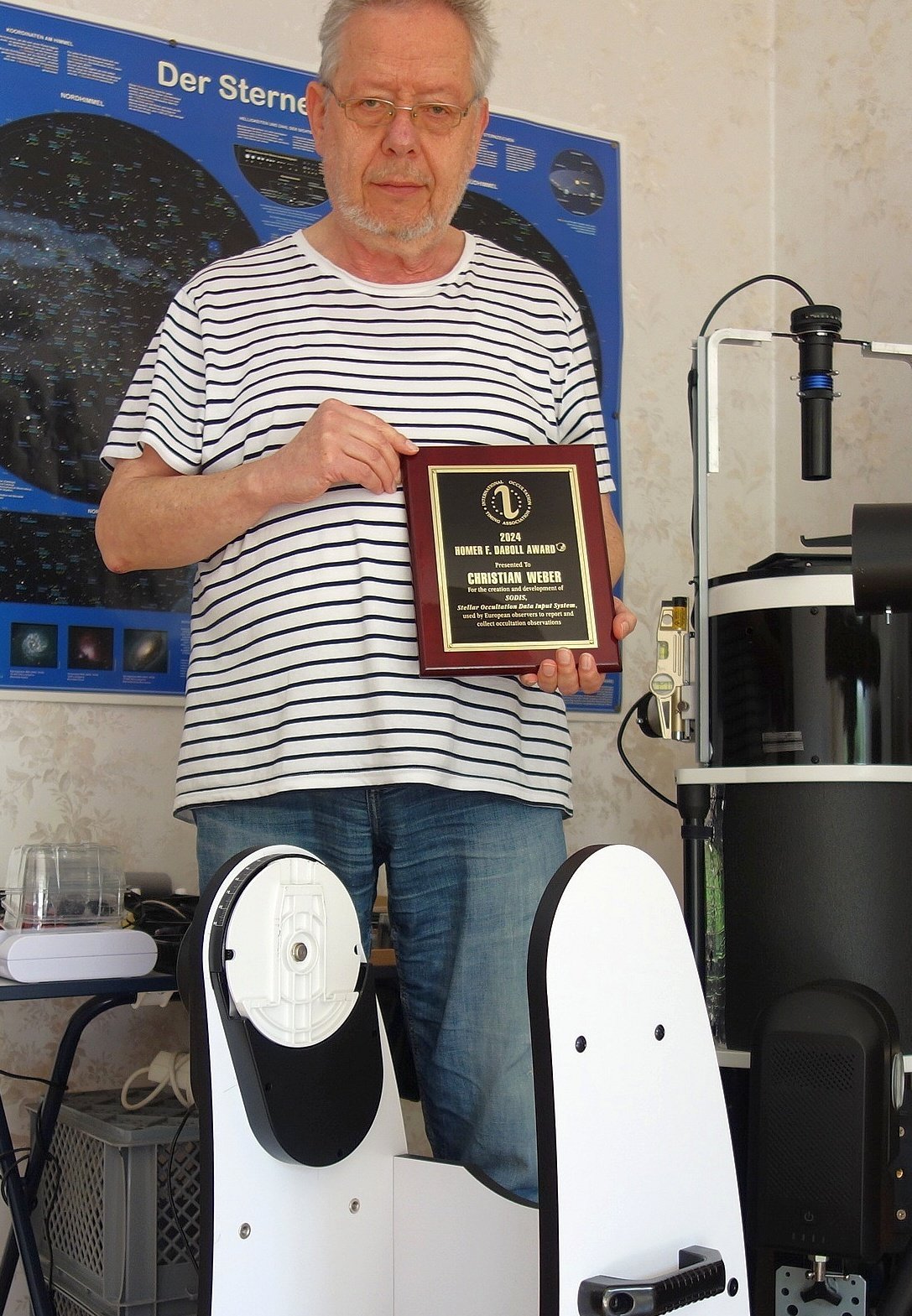
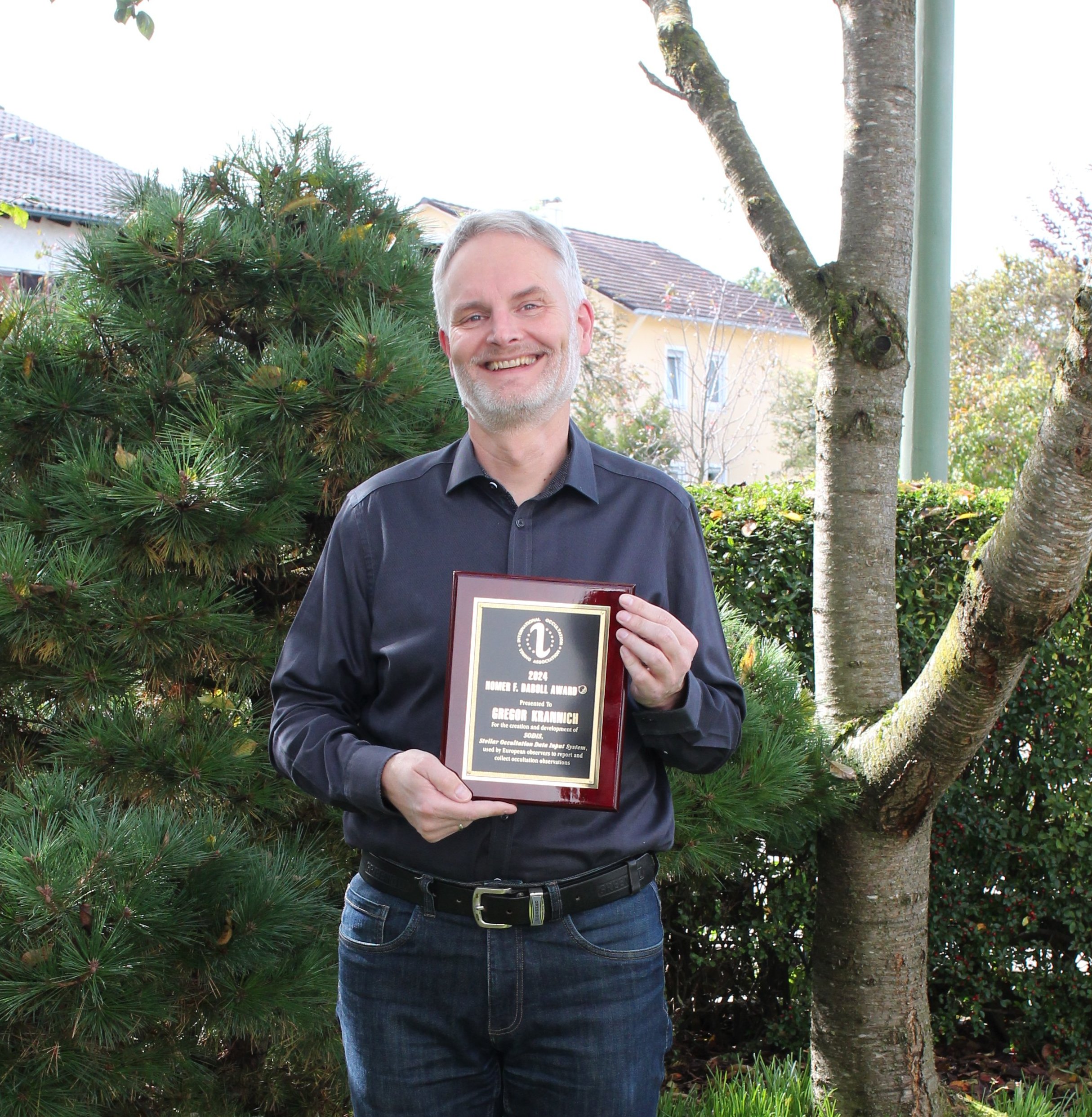
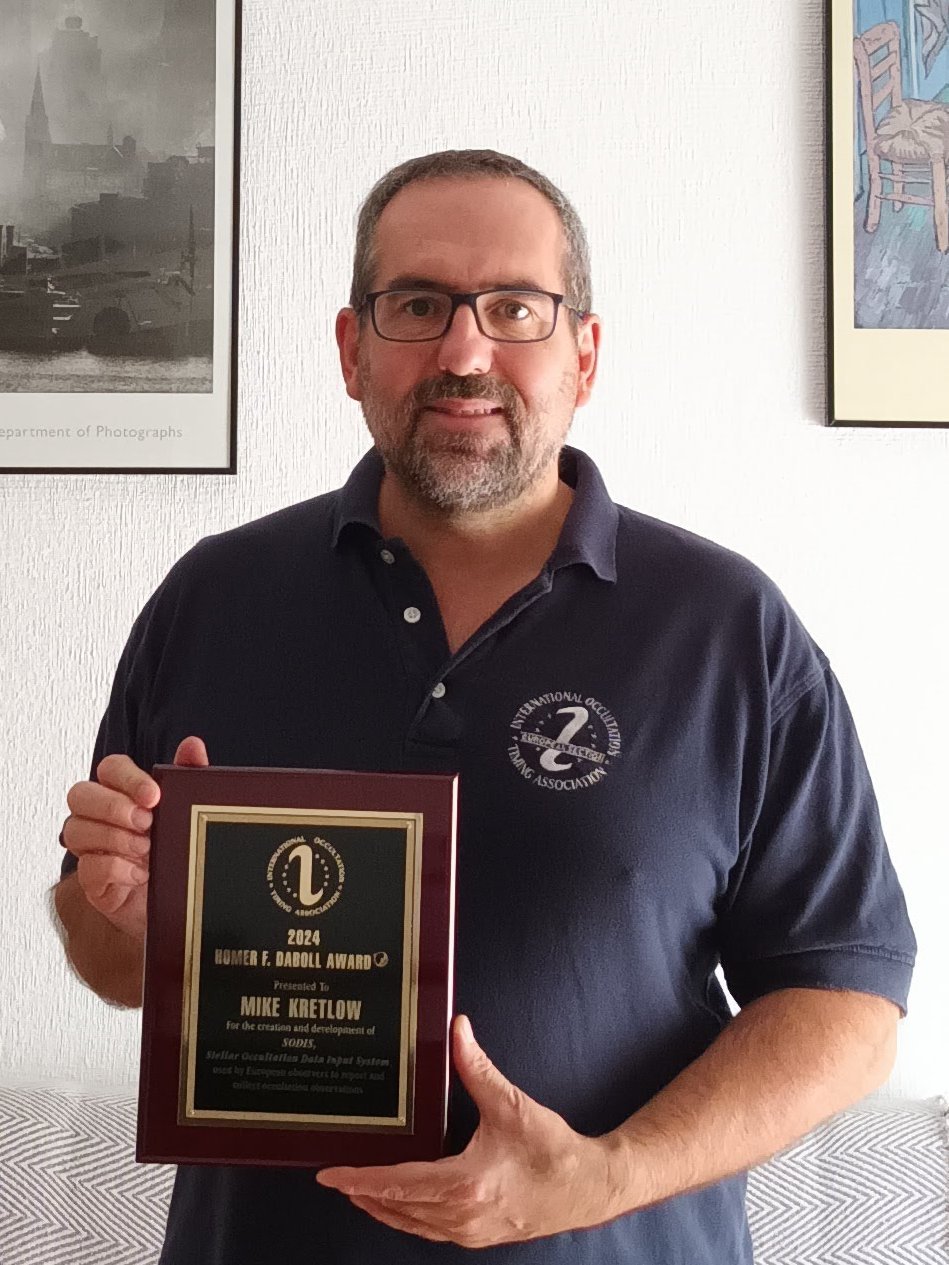
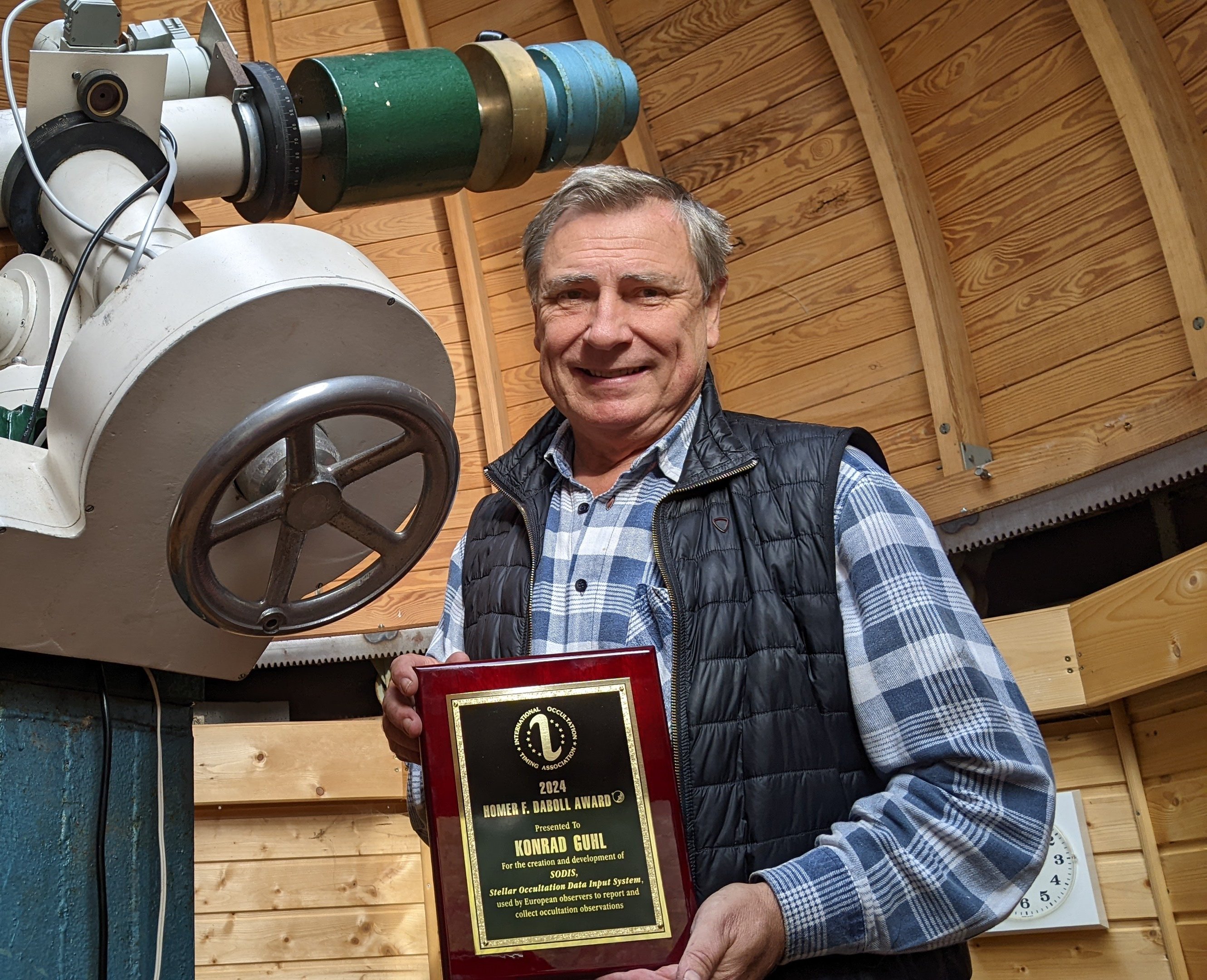
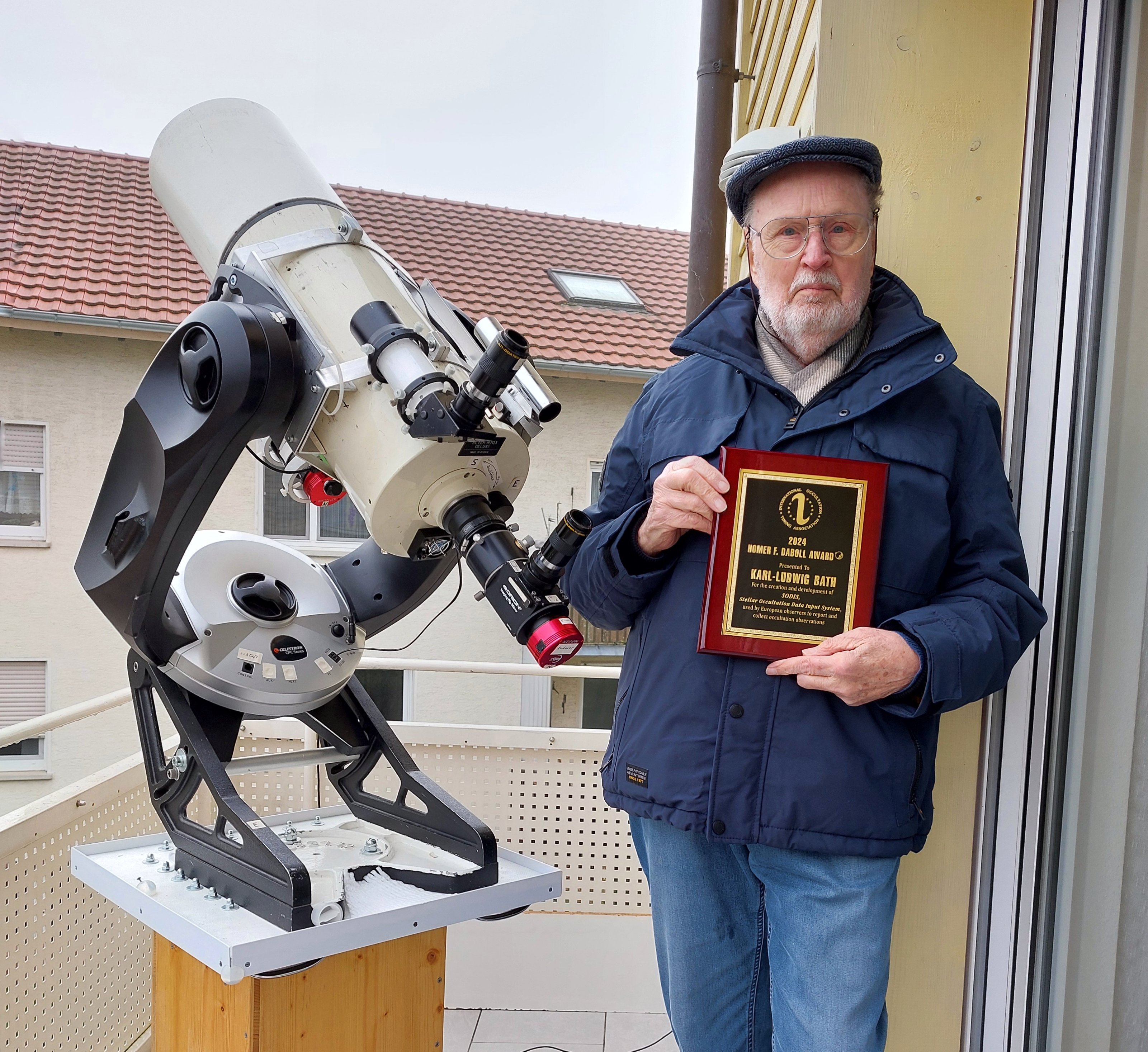
........Homer F. Daboll Award winners: The SODIS Team (Stellar Occultation Data Input System):
Dr. Christian Weber ......Gregor Kannich .......................Mike Kretlow............................. Konrad Guhl ..................................... Karl-Ludwig Bath
Other SODIS Team Homer F. Daboll Award Winners: Sven Andersson, Wolfgang Beisker, Nikolai Wünsche. Software Engineer: Erik Tunsch
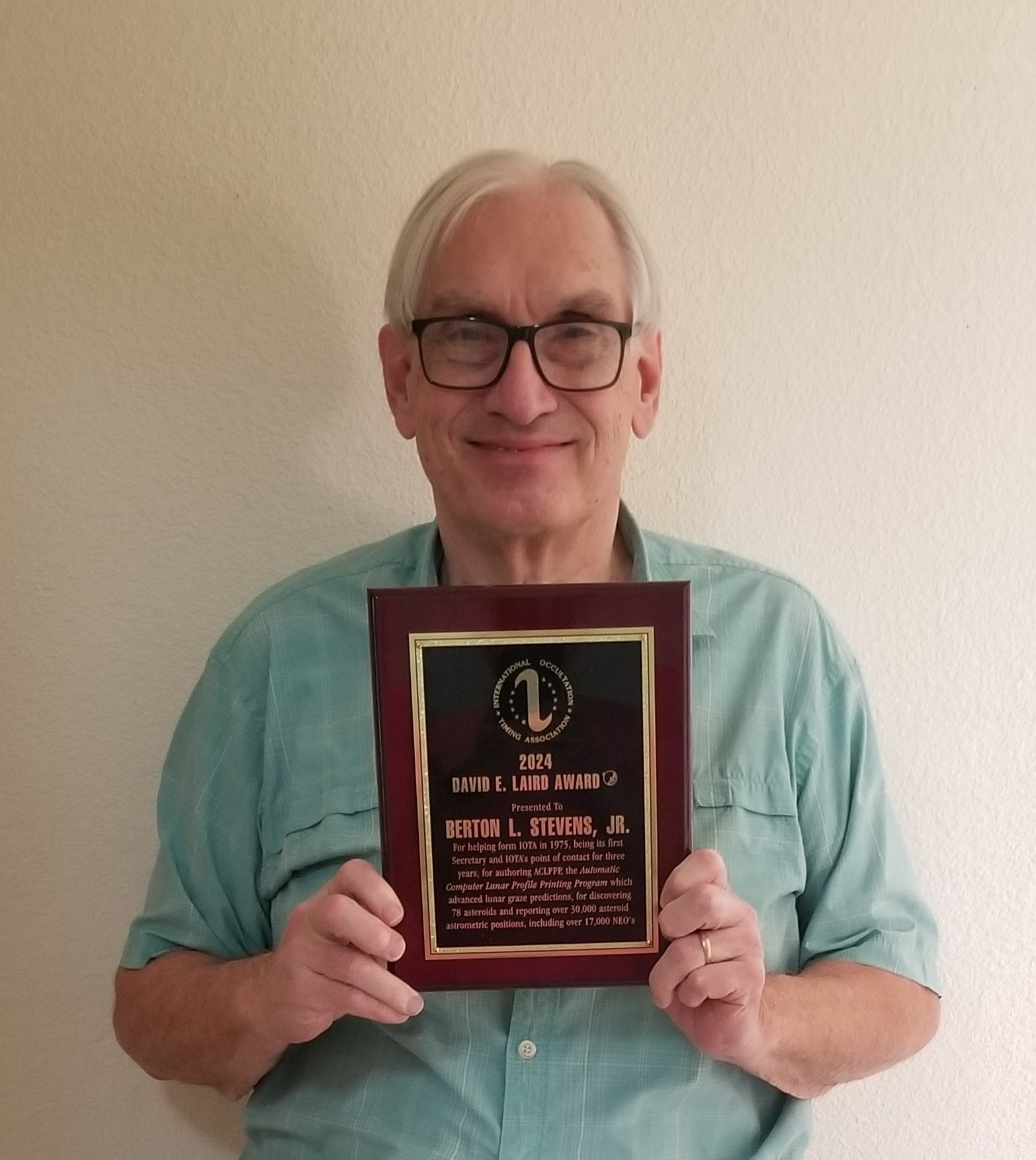
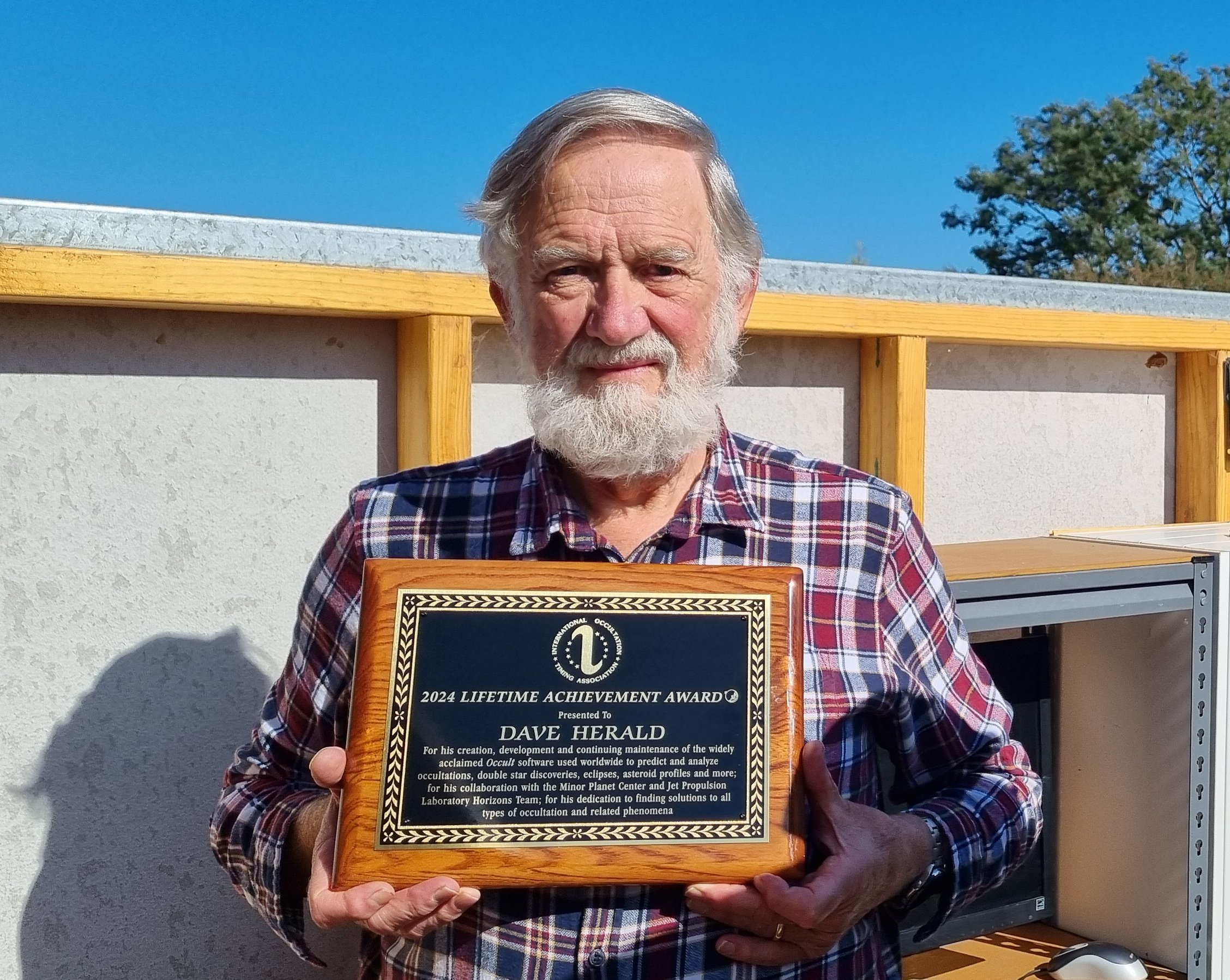
Bert Stevens-David Laird Award ... Dave Herald - Lifetime Achievement Award
Attendees: The meeting started with a total of 45 participants, rose to 67 and this number fluctuated throughout the sessions.
Saturday
September 28, 2024 20:00 UT – Meeting start
Ted Blank welcomed everyone to the
meeting. (Vice-President Dr. Roger Venable was not able to attend
and open the meeting: Hurricane Helene had knocked out his power
and internet.)
Treasurer Dr. Joan Dunham presented IOTA’s
financials and membership status. A summary of the year’s
income/expense report through August, 2024:
Income:
Expenses:
ASSETS
Special Purpose Funds:
*W. J. Merline Award for Discovery of an Asteroid Moon by Occultation (MADAMO)
Non-cash donations were made by many, spending many hours on observing activities, data analysis, software development and maintenance, IOTA administration, outreach activities, web site maintenance, and more. To everyone who donated to IOTA this past year: THANK YOU! Your support is key to IOTA’s success!
IOTA Membership and Subscription:
Voting Membership -129
Dr. Ted Swift presented IOTA’s
Homer F. Daboll, David E. Laird and the Lifetime Achievement
awards. The Homer F. DaBoll Award is given to
recognize significant contributions to the field of occultation
science and to the work of IOTA. This year's recipient of the
Homer F. Daboll award went to the SODIS Team (Stellar
Occultation Data Input System) from IOTA/ES: Sven Andersson,
Karl-Ludwig Bath, Wolfgang Beisker, Konrad Guhl, Gregor Krannich,
Mike Kretlow, Christian Weber, Nikolai Wünsche. Software
Engineer: Erik Tunsch. SODIS was created to collect
occultation observation data in an automated manner. Prior to
SODIS, Eric Frappa had collected, reduced and posted occultation
observations on the IOTA/ES website from European observers,
which was quite a task!
The David E. Laird award is given to recognize
those who, more than 15 years ago, made significant contributions
to occultation science and to the work of the IOTA. This
year’s David E. Laird award recipient is Berton L.
Stevens, Jr. from Las Cruces, New Mexico. Bert helped
form IOTA in 1975 and was IOTA’s first Secretary and point
of contact for three years. He completed ACLPPP, the Automatic
Computer Lunar Profile Printing Program which advanced lunar
graze predictions. Bert has discovered 78 asteroids and reported
over 30,000 asteroid astrometric positions, including over 17,000
NEO’s.
Upon notification of the award, Bert sent the following email:
I am honored to receive this award for my past contributions to
IOTA and our work on occultations. The David E. Laird award is a
meaningful reminder that our efforts can resonate over time.
Thank you for recognizing the value of my work in helping to form
IOTA and writing ACLPPP. I hope to start contributing occultation
observations in the near future, only they will be of minor
planets and not the lunar limb.
Thank you again!
Clear and dark skies!
- Bert
The IOTA Lifetime Achievement Award is given to
recognize outstanding contributions to the science of
occultations and to the work of the IOTA over an extended period
of the recipient's lifetime. The award is conferred by the IOTA
Board as needed. This year's Lifetime Achievement Award recipient
is Dave Herald from Murrumbateman, Australia.
A partial list of Dave’s contributions to the occultation
community includes:
• Dave is the author of the widely acclaimed program,
Occult, in use since the 1990’s which predicts all types of
occultation events, eclipses, transits and more.
• Maintains the database of all observed asteroidal
occultations, plus lunar limb data from grazes and total
occultation observations from all the IOTA Sections worldwide
(Dave Gault also plays a key role in this).
• Deals directly with the Minor Planet Center to send
updated astrometry from asteroid and other occultation results.
High precision astrometry is key for updating asteroid orbits
– JPL Horizons relies on MPC to update their database (1.3
million asteroids, 3900 comets, 293 planetary satellites).
• Communicates with VizieR to send asteroid occultation
light curves.
• Author/Co-author of over 100 papers in peer reviewed
journals.
• Longtime involvement with the solar radius measurements
during solar eclipses.
• Dave is one of the world’s most respected occultation
astronomers.
• Asteroid 3696 Herald named in his honor.
Upon notification of the award, Dave sent this email:
I am truly honored to receive this award. It has caused me
reflect on some of my many notable memories:
-1956 opposition of Mars. As a 5yo, my father showing me Mars
through a telescope he made using a blank lens for spectacles and
an eyepiece from a very old
microscope, which he mounted in a length of downpipe.
-1966 May 7 – my first lunar occultation, which I
subsequently ‘reduced’ using 7-figure log tables.
Observed with a 4cm telescope.
-1970/71. My first programing to compute a lunar ephemeris. Back
in the days of Hollerith punch cards, and core memory.
-1990. The beginning of Occult – programmed on a Commodore
64 as several modules.
-2003 Meeting Gareth Williams (the then directory of the MPC) in
Sydney, which led to the reporting of asteroid astrometry from
our occultations
-2005 Following a work meeting at the US Patent Office in
Washington, staying a couple of days with David & Joan Dunham
– which led to me taking on the
collection of asteroidal occultations globally
-Recent times – seeing the results of our observations for
some critical objects providing astrometry of greater precision
than all the professionals – a testament to the power of
what we can achieve. And, at long last, substantiated discoveries
of asteroidal satellites.
A satisfying journey of almost 70-years..... A journey where the
time to pass things on has begun.
Thanks to IOTA and 30 reviewers and exporters, and commenters.
Thanks to the observers, without whom this would be nothing.
======================
Technical sessions:
Norm Carlson spoke about “Recent Well
Observed North American Asteroid Occultations.” Norm leads
the North American Asteroid Occultation Report Team. There have
been large increase in the number of observations, so there have
been plenty to chose from: Big Events (large asteroids), small
but important events, asteroids & satellites and double star
events.
Recent Large events:
- (704) Interamnia, 306 km dia across USA, including 3
observations by J. Moore. Well covered.
(Ted Blank chat: I posted a video of my Interamnia positive on
YouTube if you need an example of an occultation:
https://youtu.be/M6GzfmMqrzc).
- P7M03 Titania, 1577 km dia, across most of USA and S. Canada.
Well covered, and had several valuable constraining misses. There
was a 200 km south shift, so this will improve future orbits.
Lessons:
• Live life on the edge: Edge chords are more valuable for
discerning maximum shape and improving astrometry.
• Elevation corrections were very important for several
small high-value events this year. These corrections can be done
in OWC. OWC draws a line to the elevation-corrected location. Two
(65803 Didymos) events (800 m diameter!), two in Sept. The second
one on 22 Sept got 4 tracks. There were 2 positives on the 19
Sept 2024 event. Didymos was about a half a pathwidth south of
the predicted path. Yanzhe Liu got a tentative positive, went
through the diffraction patterns. Points: Pay attention to the
little white lines for elevation corrected lines in Occult.
Asteroids and Satellites: (4337) Arecibo 2021 May 19 Discovery.
(276) Adelheid discovery. “Less typical” satellite
discovery for (5232) Jordaens: Observers saw either the primary
OR the secondary, but not both.
Observation just in for the Arecibo event from 14 Sept:
Overlapping bodies. Point: Multiple stations on an event often
provides more information than single stations on multiple
asteroids.
Light curves: Pay more attention to them: Examine them carefully
for features that might reveal double stars, etc. Seek out Dave
Gault’s video about sending your light curves into Vizier.
Point: Slow down for the curves: Pay attention to details, add
comments, “possible steps, possible peak”. Send your
light curves into Vizier if not submitted by the regional
coordinators.
Appendix: Review of the review process: Number of reports has
risen steeply in 2020 through 2024, though there has been an
increase each year since 2012. There were 840 North American
events as of end of Sept 2024; projecting ~1100 by end of Dec.
[Causes would include Gaia data releases and thus vastly improved
path uncertainties, beginning with DR 1 in Sept 2016, DR2 in Apr
2018, Early DR3 in Dec 2020, and DR3 in June 2022).
Jean-Baptiste Marquette chat comment: Any comments about any
contributions to the GAIAMOONS project for double targets?
https://gaiamoons.imcce.fr/
Norm next spoke about “The Review Process
for North American Asteroid Occultations.” Observers should
send in the log, report file, CSV file and light curve. Then all
files are sent out to a reviewer. First the report form is
reviewed: Reviewers have seen errors in just about every report
filed. Reviewers process the CSV to compare with the
observer’s results. They use AstRepToXML and Occult 4 to
check and combine observations, generate sky plane plot, site
location plot, update web page, The Coordinator sends light
curves to Vizier.
The North American Review Team is looking at a more automated
system, like SODIS, but for now the review team consists of Jerry
Bardecker, Steve Conard, Bob Dunford, Ernie Iverson, Steve
Messner, John Moore, and Kevin Green is getting up to speed. Tony
George handles difficult cases. Johnny Barton and Dave Eisfeldt
provide Tangra report. Dave Gault does final review.
Ted Blank, as host, thanked Norm and the review team for all
their work, and suggested that if anyone wants to join the
reviewer team, contact Norm (at reports@asteroidoccultation.com
).
Jean-François Gout presented the observation of an occultation
by (10424) Gaillard, which revealed the binary nature of this
main-belt asteroid. Details were shown of how the light curve was
analyzed to rule out alternative hypotheses (such as a binary
star) and how he acquired additional data (light curve) to
confirm the binary nature of this asteroid. Asteroids can have
moonlets. Equipment used: C11 Edge HD Hyperstar STD, large FOV,
ZWO ASI 533MM 1.2 deg FOV. He made a small roll-off shed
observatory for his setup.
(10424) Gaillard has an estimated diameter of 6.5 km. Discovered
1999 by OCA-DLR Asteroid Survey. Named for Boris Gaillard by
Alain Maury (Note the French theme; though Gout is in
Mississippi, USA).
The event on 2024 Jan 14 was max dur 0.71 sec, Probability 76.6%.
Jean was very excited when viewing in real time. The two events
with a total duration about as long as expected. It was not
scintillation, a cloud, bird or an airplane. Was it a binary
asteroid or binary star? Looking more closely at the light curve:
With a binary asteroid, each component would be expected to block
100% of light from the target star. A binary star would have
different depths, except in worst case with both components being
the same magnitude. The point is to check the total mag drop and
drop to background black. Still to be resolved: Is it a binary
asteroid or dog bone shape? Collaboration with Matthieu Conjat
and a 40” telescope, light curve details and confirmation by
Tony George and Dave Herald and the event was reported to CBET. http://www.cbat.eps.harvard.edu/iau/cbet/005300/CBET005370.txt .
There have been three officially recognized asteroidal satellites
in just 18 days!.
Conclusion: Keep observing. Small ~10km asteroids are likely to
be binary. Improved SNR is needed to detect difference between
noise and a binary.
President Steve Preston gave a talk presenting a
few of the better “easy to observe” asteroid events for
the rest of the year. The events were mostly in the North
American region with a few crossing other regions. The best 2025
North American asteroidal events included "Easy”
events: Bright, paths well constrained, etc., < 0.1 diameter
uncertainty.
World: Europe 9 Jan Thisbe, SE Asia Gutenberga; Rhea across
Japan, Erigone across S. Australia, Pulcova across S. Australia
and E. Africa. Dynamene over N. Europe.
Dr. David Dunham presented a talk about
“Important NEO, Trojan and KBO Events for the Coming
Year.”
In late 2024 and 2025 David acknowledged Steve Preston’s
contributions. The 2025 events will be going into the RASC
handbook. (outline):
(4337) Arecibo plots by D. Herald. An astrometric
“wobble” was found by Gaia; Lucky Star has predictions
for Gaia Moons shows path with two shadows. 14 Sept 2024; Occult
can overlay series of observation lines, for example Dr. Richard
Nolthenius had a “Pillars of Hercules” event!
Norm also talked about Didymos. Scatter plots of NEAs are on the
Web site and RASC for 2024. Some important ones are Phaethon 8
Dec and 22 Dec. Two on 8 Dec: Phaethon, Florence, Didymos,
Sisyphus. Toutatis may be an Earth impactor: It is thus important
to refine its orbit by occultation. See the list in RASC.
Dave listed late 2024 Patroclus-Menoetius events.
2024 Distant object event: 9 Oct 0 UT 11.4 mag by Neptune.
Bienor over Albertan and Echelus over Cuba.
2025 bright events across N. will be in RASC observers Handbook
including NEA occultations.
2025 Special Main Belt occultations were listed for the handbook
and posted online.
234 Barbara 1 Jan 2025: Contact binary, SF Bay area to GA.
Westerwald is target of UAE mission. Special MBA Bright
occultations:
Agamemnon 5 Feb over Florida
Distant objects 2025 Dec 13 Elara, 2 Aug Umbriel with the North
limit over US SE, MX.
A list of many of the URLS to be shared after RASC handbook
Frank Marchis, Tom Esposito, Ryan Lambert
presented the talk: “Stellar occultations by the Unistellar
Network.” Marchis is with the SETI institute. Unistellar
started as a Kickstarter project, it now consists of 4 models.
These smart telescopes are small, compact, easy to use and have a
CMOS sensor. Images/videos are sent directly to cell phones with
an approximate ~70 ms delay. Some 17,000 of these telescopes have
been sold. The tag line to encourage occultation participation is
“Come for the images, Stay for the Science”. There are
telescope software updates every 3 months or so. The education
foundation Unistellar College Astronomy Network (UCAN) is for
developing Citizen Science. Dr. Daniel O’Connor Peluso was a
Unistellar Education Associate & Exoplanet Assistant
Researcher from 2020-2023. He has a paper in regards to this
research submitted to the Astronomical Journal (AJ). These
telescopes have been donated to Astro Clubs, where one can get in
contact. The majority of these telescopes are in US, Europe,
Japan; more are coming in Argentina, E. Africa. A Citizen Science
program with Charles University in Prague has been established
with Dr. Josef Hanus as the occultation lead.
The science pipeline is housed on Google Cloud; and reported on
Slack. Unistellar’s main website is
https://science.unistellar.com/ . It has a live view of uploaded
observations, live view for processed data. This site is not only
for Unistellar users! There are Citizen Science programs on
several topics: asteroid occultations, planetary defense,
exoplanets, comets, cosmic cataclysms and observations of
satellites, the most concentration is on occultations.
The telescope/camera field of view (FOV) is about 0.5 deg. The
software can generate a light curve automatically. The
controlling computer/tablet/phone sends observer reports to the
analysts. The program is open to all. For occultations, the
maximum brightness Unistellar can reach ~ +11.6, durations >
0.5 s, minimum magnitude drop > 0.9 mag, asteroid size >5
km. Globally over 1,600 asteroid occultations have been observed
(positive and negative)
https://science.unistellar.com/asteroid-occultations/results/
with predictions for specific observer positions. Automatic
processing is in the works for rapid reporting. A decision was
made to prioritize science on space mission targets and NEOs.
On how to observe: From the Unistellar website, join Citizen
Science, generate a calendar under “Find your event”.
The group would like to formalize prediction arrangements between
Unistellar and IOTA.
Contacts: fmarchis@seti.org and hanus.hom@gmail.com.
A few Q&A’s:
Q: After an occultation, how long does it take to get to IOTA? 1
year. Leaders wanted to make sure the pipeline is accurate. Want
95% positivity/negative before speeding up transfer to IOTA.
Q: Are there plans for future telescopes with larger apertures?
Yes, but challenge is to keep weight managed. The market for
small telescopes is higher than for large telescopes.
Dr. Roger Venable was scheduled to speak, but he’s out of
communication from Hurricane Helene. Dr. Joan Dunham then
presented one of her Sunday talks.
Joan then talked about using a Windows 11 laptop for occultation
recording – Ideas on how to prepare Windows 11 laptops for
unattended occultation recording.
Past efforts to make an automatic recorder worked with Windows
10. It is more difficult with Windows 11: There are different
TYPES of Windows 11, so a single instruction set is hard to
provide. Thus, we’ll present this for data capture, but NOT
unattended operation.
Issues are:
Caveats: These are not endorsed by MS. It is based on Windows 11
Home v 23H2 “SunValley 3”
-Capture data while offline,
-Data is captured to one’s Laptop not the cloud,
-Ability to connect
-Goals: Minimize interruptions, minimize distractions,
-Prioritize occultation activities without drops.
-Dangers: Dead battery, permission denial
-Nuisances: Suggestions, Widgets
-Danger: Default may be “turn on upon opening Laptop
lid”, aka “flip to boot”. The control is variable,
it may be from the command line. Thus, set your screen to never
sleep.
-Core isolation: Switch controlling memory integrity, may prevent
some drivers from loading, suggest enter Device Security in the
start search
-Nuisance: “Welcome to use Smart Key”: Floats, and may
not have a “Cancel”
-Do: Reduce or eliminate storage to cloud One Drive.
-Use dark background and night mode
-Only turn off with specific request
-Operate your computer as an Admin
-Control updates: Stall or suspend Windows updates, Cannot always
control updates from non---MS sources. Turn on Airplane Mode.
Enlarge the pointer and have it turn white when over large dark
area.
-Show seconds on the system tray clock
-Disable MS monitoring
-Turn off Dynamic Lock
Example problem: No problems noted at the time, but PyOTE showed
exposure frequency much slower:
-WiFi mount to laptop comm or the iOptron Commander,
-Solution: Don’t use the WiFi connection with iOptron.
Compare the actual frame sequence with the exposure. For the
future: Working a table of options found under Settings, note
which features may affect an observing session, provide
suggestions, table will be posted on Occultations.org.
A few comments received during the talk:
Steve Preston comment: USB traffic setting in SharpCap.
Alex Pratt chat: Enabling display of Seconds can use more system
resources. Be careful if computer is lower spec.
Jean-Francois (Jeff) Gout chat: And if you can use a smaller ROI,
it can also help with this type of problem.
Ted Blank: Option in settings: “What to do when I close the
lid”, choose “nothing”.
Alex Pratt chat: Computers can have both USB-2 and USB-3 ports.
Check your model.
Daniel Schultz chat: Windows was never intended to be a Real Time
operating system, why not switch to a Raspberry Pi or other Linux
variant? (doesn’t support Windows computers)
Jan Mánek chat: Actual FPS is shown on status line on SharpCap
window bottom. Should be always checked if matches with exposure
settings.
Jean-Francois (Jeff) Gout chat: Basic Linux is NOT real time
either...
Jean-Francois (Jeff) Gout chat: And I strongly doubt Raspberry Pi
is real time.
Daniel Schultz chat: There are OS's that are designed to be Real
TIme,
Steve Preston to You (direct message) chat: Right... Neither
Linux or Windows nor Mac is a true Real Time OS. Rpi is based on
Linux. Linux does have one advantage over Wi
Over Windows... Linux does NOT force updates
Hristo Pavlov next discussed Occult Watcher
Recent Updates. A lot of development in the OWC space in the past
few months. A group of beta testers have been commenting, almost
ready to present. Most observers us OWdesktop, which has a couple
of limits: Limited to feeds, and some people want to do more. OWC
will precompute a lot of events through the next 2 months and
make them available. One search page is for search by Object,
where you have a number and date. There is a need for a more
advanced search: Filter events based on visibility based on set
of parameters. Hristo discussed several parameters and options
for doing searches and advanced searches such as your location,
distance from the errors in the path, etc. OWdesktop event
filters are more limited. And OWC is working with a much larger
pool of potential events.
~~~~~~~~~~~~
SUNDAY, September 29th 20:00 UT – Meeting start
Dr. Roger Venable called the meeting to order on
time. His power and internet has been restored after Hurricane
Helene.
56 attendants were on hand at the meeting start.
Mark Simpson began the day’s session
presenting “The Astrid Imaging System.” Mark
described the ASTRID system. He started doing occultations in
March 2023 and wanted figure out the best method for doing them.
Some of the problems regarding recording equipment were that cell
phones have variable frame rates, QHY required problematic
firmware updates, and the EVScope’s raw video couldn’t
be converted (it required extraction from cloud; not available)
Cell phone timestamps are only accurate to 1 sec, and their
compressed video is poor. This impacts the quality of the
scientific data and has resulted with many questions. Analog is
going away and is difficult to source. Digital is here now. And
time-based accuracy is the key.
Wish list: The system needs to be cheap and easy to repair,
Double duty (astrophotography and occultations), easy to deploy,
with a consistent paradigm (ASI Air/Nina, etc.), a global shutter
and accurate timing to eliminate debate. And all this in a single
unit, connected by wireless. Thus the ASTRO Imaging Device
(ASTRID) was born.
Astrid is a self-contained unit (with a Rasp Pi 4 camera,
timestamp and software) that plugs into the eyepiece, has a
wireless connection (VNC, Remote Desktop) and provides accurate
timing. It operates off a 12v DC supply, Mark did not recommend
cheap 12V “power banks” as they can’t supply
advertised current. Exception: Celestron power packs are fine.
Astrid has switchable camera sensors, mono or color (it’s
shipped with mono now), has Goto plate solving, polar alignment,
synchs to OWC, thus reduces user error, has audit trail, report
fitting (for NA form). There’s no compression, frame
triggered all this in a 3D-printed case with a small fan on back.
ASTRID camera is an all encompassing occultation recording
system. ASTRID can be attached to a T-slot telescope mount made
by John Broughton. It is described at https://github.com/ChasinSpin/TSlotBroughtonMount.
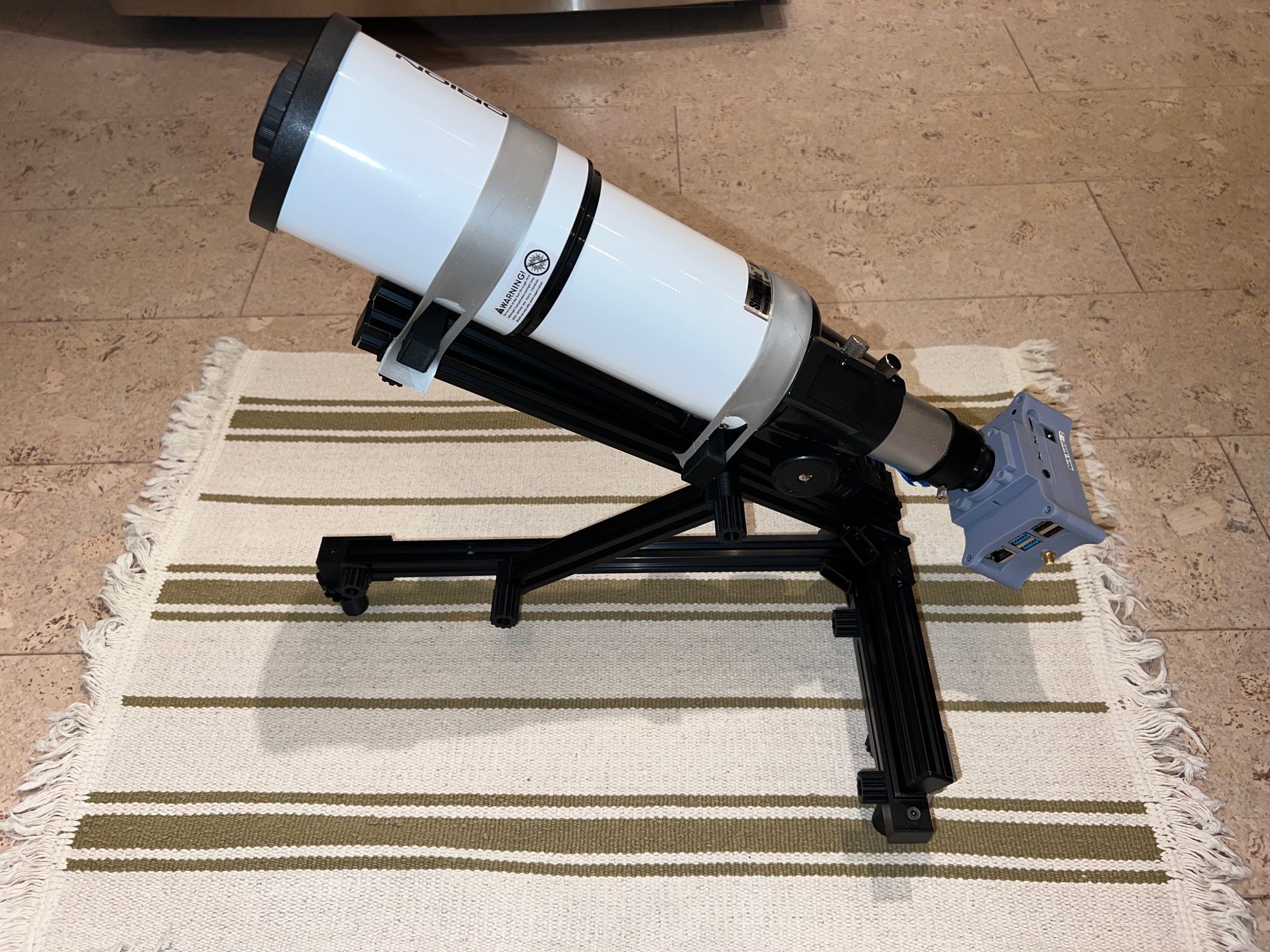
T-Slot telescope mount with Astrid attached
There was quite a few chat comments:
Ted Swift asked on chat: Can ASTRID be set up to do time-lapse
(record a frame each second for 8 hours) for, e.g., eclipsing
binaries? Tom@tomheisey.com replied by chat: Ted, the ASTRID app
does not have a timelapse function.
V Sempronio chat: what material is the case made from? Ted Blank
replied by chat: It is 3D printed but Mark will have to confirm
the type of filament used. Steve Preston via chat: The original
cases were printed in Resin. The current cases are FDM.
Ted Swift asked on chat: So if you move, ASTRID knows the path
timing (from OW?), so it automagically adjusts the recording
times? Very cool!
Bill Yeung chat: Mark, my record is as low as 12 degree east
Tom Alderweireldt chat: Isn't it limited in framerate by the
Raspberry Pi SD card, or does the setup use faster SSD storage ?
V Sempronio chat: what is the screen resolution of the ASTRID
when connecting to it remotely?
Tom tom@tomheisey.com chat: The "qualify drive" script
tells you the frame rate of your USB drive. He has a list of
drives that have enough speed.
Steve Preston chat: Frame rate is limited by the camera board,
the rPI and the speed of the USB Flash drive.
The screen resolution is determined by the VNC client... and
therefore varies depending on the iPad, tablet, laptop used for
the client VNC connection.
The units from IOTA are shipped with USB Flash drives which
qualify to run at 60 fps.
Tom tom@tomheisey.com chat: You can stretch the screen to fit
your device. I'm using a 1200x800 cheapie tablet and stretch the
VNC window to fill most of the screen.
Ted Swift chat: What would be involved in donating an ASTRID to
an observing team in a distant country sight unseen? (parachuting
in)? Seems to me most things are taken care of (as long as
English can be used).
Steve Preston replied by chat: Donating an Astrid... someone
needs to pay the cost of the Astrid + shipping.
Ted Swift chat: Steve: Yes. I'm thinking of the "last
mile" issues: Mailing an ASTRID to, e.g., Namibia or Kosovo
to a team that's new to occultations: How to assure that the
setup gets implemented successfully. Clearly would require
agreement and discussion beforehand. Ted Swift chat: I was
thinking if one wants to donate an ASTRID to a distant team
permanently.
Michael Oconnell chat: Can the plate solver account for hot
pixels which may accrue over time?
William Hanna chat: Does it suggest a rotation of the Astrid in
the eyepiece holder to ensure that the long axis of the FOV is
aligned with the RA direction?
Tom Alderweireldt chat: can it improve on the horizontal banding
(readout noise) ? bias correction ?
Tim Haymes (UK) chat: Sorry if this has been covered: Is FITS an
option?
Ted Blank chat: Bill Hanna, if you are tracking it won't matter.
If you are pre-point drifting, then that makes sense to maximize
the amount of time the target star is on the field.
Steve Preston chat: Astrid records to RAVF - a format which is
matched to the sensor layout - for performance. You can convert
RAVF to FITS later.
Jean-Francois (Jeff) Gout and Richard Kelley ask via chat: What
would be the maximum focal length that the plate solving or polar
alignment work? Mark says focal lengths up to 3-4 m is
workable(!). Steve Preston chat: I'm not sure of the maximum
focal length for plate solving. Astrid uses the ASPS solver which
does work with long focal lengths. And I have been successful
with my C14 at the native f10 (3500mm). This did require a longer
exposure to capture more stars. Steve Preston chat: Also on focal
lengths... I strongly recommend trying to get your focal length
down to 1000mm or less - largely because this shorter focal
length will improve the SNR of your recordings.
Jean-Francois (Jeff) Gout chat: Very impressive! Does ASTRID also
make coffee and keep it warm for when the observer picks up the
ASTRID in the morning?
Tim Haymes (UK) chat: Is there a tool for focusing ASTRID? Tom
tom@tomheisey.com chat: I use a Bahatinov mask. David Dunham
chat: Astrid doesn't focus; you have to use the focus knob or
control of your telescope. Steve Preston chat: Astrid does have
an option for measuring the focus accuracy. Mark has not yet
added support for focusers. But he may do so eventually. Astrid
uses INDILIB to access the mount and other devices. INDILIB does
support focusers.
JHMiller chat: Cost? Joan Dunham chat: Order via Recommended
Equipment « IOTA (occultations.org), see the cost there. Ted
Blank chat: The new "Prime Focus" version will be about
$35 USD more than the "Refractor" version due to the
extra parts. David Dunham chat: Astrid costs just under $700,
available from
http://occultations.org/observing/recommendedequipment/Astrid
Jean-Francois (Jeff) Gout chat: Is IOTA planning on having a
bunch of these ready to ship to observers for temporary use to
observe important events? Steve Preston chat: No plans for
"loaner" units at this time. I suspect the challenge
will be finding a volunteer to "manage" a loaner
program.
Currently some 60 Astrid devices are being used, some by IOTA and
adopted by IOTA in several countries.
Steve Preston chat: CORRECTION... the Astrid units shipped with
flash drives qualified to run at 30 FPS. Faster rates may see
dropped frames.
Mark Simpson chat: If anybody had any questions we missed, feel
free to email me at chasinspin@icloud.com.
Jean-Francois Pittet chat: How long to get on target? Quick.
SharpCap has its own catalog, to about mag 8. Joan was able to
get on target with only 20 minutes warning; took only 15 min.
Steve Preston got on target within half an hour; even push-to.
Dr. Joan Dunham talked about plate solving with
SharpCap Pro. She discussed plate solving and illustrated using
that technique with SharpCap Pro, with particular attention to
plate solving for assisting in observing with non-automated
telescopes. With plate solving the software compares the field of
view of the telescope/video to the stellar database and makes
adjustments of the two until the desired FOV is acquired. This is
analogous to image registration. “Plate solving/Plate
reductions” is a term that came from matching star catalog
positions to images on glass photographic plates. Astrometry.net
provided rapid method for solving: Indices of quads, data and
software are in the public domain. Nova.astrometry.net is freely
offered. Sharpcap requires some external programs, SharpSolve to
work properly.
SharpCap tools: Plate Solve Only, for no mount control. She
showed an example using 2 point alignment; the stars need to be
in both hand paddle and SharpCap. The target can be specified by
RA and DEC, then hit Start. One problem occurred with the mount
pushed off target, and couldn’t recover in time; it was
learned later that it would have been a miss. Pros and cons. Good
plate solving requires about 100 stars. Plate solvers need FOV
and focal length; astrometry.net can provide first guess.
Michael Camilleri spoke about inexpensive GPS
timing - "How to turn any astrophotography setup into an
occultation rig for < $20." Two inexpensive and accurate
methods of timing, GPS flash timing and GPS PPS to PC timing are
described. These can be used with most PC setups and any type of
camera (CMOS, CCD, rolling or global shutter) with remote and/or
unattended use possible. At <$US20 for the cheapest method
they are ideal for new or casual occultation observers to get
started using their existing equipment.
Steve Preston talked about “The GPS Flasher
Device.” The GPS flash timer is for cameras that don’t
have timing built in, e.g. planetary camera. Ways of
transitioning to occultation observing are needed and the flash
timers offer an approach. Components are the IOTA-GFT device
(John Moore printed box), LED holder on scope, GPS antenna, the
recording computer that has an IOTAGFT app and FitsReader app
(Bob Anderson). The current release supports SharpCap; future
releases can support Linux or Mac assuming we can identify
recording software on these platforms. Gout says FireCapture
works well on Linux and Mac.
Status: The timer is ready for Beta testers, will start building
more after testing. The cost will be about $150 built, open
source if one wants to DIY. There is support for Sharpcap
sequences (already mostly implemented). Bob Anderson developed
the software and J Moore developed case.
Q: Can you program before and take out? Yes, that’s the
goal; Bob has talked about it; it would be on the recording
computer; possible.
Q: Ted Blank: How does the app talk to SharpCap: Device can tell
Sharpcap to start recording, then flashes, records event, then
flashes, then stop recording. The log file records flash timings,
timestamps frames that have timestamps, interpolates
automatically, unless it has problems.
Kevin Green reported a summary of “College
and High School Student Involvement with Occultation Observations
in Connecticut (CT).” At the University of New Haven;
he’s trying to get students involved in occultations
including people from the local astronomy club. The NE USA has a
Yahoo group: OccultNEUS; Several IOTA members are in this
discussion group: Viscome, Conard, Kamin and others; the goal is
to get more scopes on more events to get more chords for asteroid
events. The stations are still too far apart to get multiple
stations.
Goals: To get multiple scopes on more events which leads to
better astrometry, detailed asteroid shapes and possible
satellite detections. Automated scopes via Sharpcap allowing for
unattended observation are being considered, details are still
being worked out. Some Univ depts require some research activity
and this provides an opportunity to recruit more observers.
Public involvement and local training will create the next
generation of scientists, engineers and educators; We see a lot
of gray/white hair in this meeting. We’re helping the next
generation get started. https://groups.io/g/OccultNEUS/topics
The John J. McCarthy Observatory in western CT has been doing
astrometry for years and has a pipeline of students. The Main
scopes are a 12” Skywatcher and a 9.25” second scope.
There is a course in astronomy with a lab scheduled to be offered
in spring, this will require buying more scopes. Cameras have
been purchased via a NASA CT Space Grant; not just for academics.
The hook: “Do you want to do science that will get to NASA?
Something new that no one has ever done before?”
Comments: Jean-Francois (Jeff) Gout chat: Do you have plans to
use these scopes for other things than occultations? Maybe
photometry? The main reason I asked is that students might go
through an entire semester without recording a positive event if
they are unlucky with weather - Having something else to get
exciting data on clear night without occultations would be nice.
Ted Blank chat: There are many known and suspected double stars
that are frequently occulted by the moon. Lunar occultations of
suspected double stars come frequently and can be seen at
reasonable hours from many locations without any travelling.
Recording these with students is a low-risk high-reward activity.
They would be unlikely to go a whole semester without at least
one of these being seen - if you are in the path and it's not
cloudy, it's a guaranteed positive with real scientific value.
Dave Herald's original presentation was
scheduled to be “The Best World-Wide Asteroidal Occultations
Since Last Year.” This was changed to subjects that are
important to consider for our future. Dave has several concerns
(though not criticisms) of the occultation process.
One concern that Dave mentioned were time issues which is the
most critical component of our observations. Three recent
observations were compromised by time issues, two involving
Didymos – the asteroid of NASA’s DART mission. With
video, we have documented extensive testing by Gerhard Dangle and
others (Bob Anderson) however we don’t have an equivalent
analysis for time devices. Concerns are:
1. Have camera delays been adequately tested for accuracy and
reliability?
2. Any variations depending on camera?
3. What assumptions are made? -How do you know what you know?
4. Does IOTA need to have some formal process of certification a
time system reliability, with testing documented?
5. Does camera behavior change with sub-framing, other delays?
Occultations provide the most precise method for astrometric
positions, and timing is the most important underlying
measurement. A lack of confidence in timing opens up controversy.
Example: Reviewing all observations: Two neighboring chords with
an offset
On Sub-frame timing: Some people desire the greatest time
precision/resolution, down to 1/10 of one exposure time. Half an
exposure or less may be reasonable. Given the typical noise, that
accuracy is unjustified. When pulling together several
observations, high precision is probably unjustified. For single
chord events, the uncertainty will be a large fraction of the
asteroid’s size. For multiple chords, shape and consistency
are issues. Doubling the exposure can’t maintain time
accuracy as time resolution is lost.
Astrometry issues & Single chord observations: Single chords
on small asteroids are highly valuable. A small mag drop events
can present a challenge since the interpretation can be
questionable. The real challenge is to distinguish between
positive and negative event. Dave is seriously considering
situations for events where a mag drop is <0.4, without a
light curve. Thus submission to Vizier may not occur.
Prediction uncertainties: With drastically reduced uncertainties,
the focus for a multichord observation should aim at shape size
determination, not astrometry. Single chords are very valuable
for the astrometry. Greater uncertainty of small asteroids make
single chords more valuable.
Light curves: We are now getting light curves (LC) for the great
majority of the observations. In Occult, they are displayed with
the event. Some are extremely clear, with easy processing. Others
raise questions. We’ve found several instances of double
stars, and a satellite that were not identified by the observer.
The value of having experienced interpreters reviewing light
curves increases the credibility. Dave is involved in combining
occultation astrometry with Gaia FDR3 asteroid astrometry. There
were quite a few events where the reliability of the occultation
result had questions. When LCs were available, the focus rapidly
switched to the Gaia data issues. People should consider creating
LC files for past observations. You might find some interesting
new features.
Quick demo of what Occult does with LCs. Something came up in
discussion group: Events missing in OWC and issues in processing.
Occult is the source of all processing. Occult can display past
events searched by observer, etc. To view an event, select
Historical Observations. There are many options for plotting,
including LCs used for event: If you see the full AND partial
drop - is that due to double star, or poor SNR? Thus always try
for a better SNR.
Workloads. Huge increase in # of events observed, >50% year
over year, no sign of reducing, several automated observers.
There are many single chord events involving small asteroids,
especially for automated systems. Current reporting systems has
evolved when most observations had multiple chords, now this is
the exception. This raises the question: For observers who report
a large number of events/year (>40) if the asteroid is smaller
than a certain size (10 km), should the observers submit a fully
completed OBS.xml file ready for inclusion in the main database?
Consultation with regional coordinators needed, but it might
reduce the workload, though quality control (QC) and quality
assurance (QA) is still needed. The real problem is our multiple
regions, each has a different way of collecting and analyzing
events. The reporting system needs to be reviewed.
Succession planning. As one gets older, one must consider the
future. Concentration of expertise. There is a high dependency
and workload on small number of people. Hristo, Herald, Gault.
There is open source software, but expertise is a concern.
(software backups are only part of the solution).
IOTA’s knowledge and expertise too concentrated. At least
one person in each region is needed who is fully competent to
fully process observations, where they can be added to the main
database to Herald’s level. This will ensure there are
several people who can take over. This is needed by the
organization.
Strong quality assurance (QA) is critical. Our results have a
high reputation because we have a rigorous QA processes (which
could be better documented). Significant learning is involved in
succession. QA is challenging in amateur groups; people
don’t like being questioned, people are enthusiastic about
their observations and interpretation. Unusual observations need
to be backed up by evidence of high quality.
QA can provide challenges, and potentially arguments. Rejecting a
review is unacceptable. The other extreme: If an observer is
uncertain about their observation they may not challenge the
reviewer. The balance is right and proper when we’ve got the
right result !
Workload pressures: We can’t afford the luxury of lengthy
debates on an individual observation unless it’s a
significant event (e.g., Didymos). And there is desire to spend
time on single frame events.
A discussion followed:
Q: Vince Semprono: Good stuff. Our data might save the world. As
for dealing with backlog, is there a priority system in place?
Obviously NEAs have priority. Could other regions take on part of
the load? Is that too political? Some regions have large number
of events. There is no spare capacity. Europe’s SODIS system
has 20 people involved; Wolfgang might comment. Language issues
are challenge but manageable. Herald is concerned about how much
time is spent in taking individual observations. Main other
challenge is to get astrometry out promptly to update orbits;
would like to get to reporting to MPC monthly.
Wolfgang: One of the issues is emphasis on light curve; you
don’t necessarily see the length of the light curve; not all
the noise reflected; should set guideline of requiring full CSV,
make event only 20% of LC. DHerald agrees. He would like to have
the whole LC recorded as a matter of course. Steve Preston urged
submitting full light curve. Observers should be easily able to
upload CSV files to Vizier (maybe through Occult). Sending the
CSV without tying it to the event would be a problem. PyOTE picks
up the metadata from the Excel spreadsheet.
Dave wants to see more testing of assumptions in practical
settings. We can put things on a basis of mathematical
principles, but we need to test things related to time that are
based on untested assumptions. One possible test: A variety of
equipment can be tested at the same place on an event. (Roger
argues for only changing one variable at a time). We need to
scrutinize our “unknown unknowns”.
The meeting ended at 2:00 UT September 30th.
Summaries of all IOTA's annual meetings are at: http://www.poyntsource.com/Richard/IOTA_Annual_Meetings.htm
The International Occultation Timing Association is the
primary scientific organization that predicts, observes and
analyses lunar and asteroid occultations and solar eclipses.
IOTA astronomers have organized teams of observers worldwide to
travel to observe grazing occultations of stars by the
Moon, eclipses of stars by asteroids and solar eclipses since
1962.