QUASARS EJECTED FROM NGC 4258 (M106)?
NGC 4258, M106
Right Ascension : 12h 19.0m
Declination: +47 deg 18m
Distance: 3 - 7 Mpc.
Visual Brightness: m= 8.3
Apparent Dimension: 19x8 (arc min)
Still another well known nearby galaxy is causing professional astronomers to scratch their heads and re-think some of the classic theories about galaxy evolution and the interpretation of the cosmological redshift as a distance indicator.
The bright Sb spiral galaxy NGC 4258 (M106) shines at apparent magnitude 8.3 and is easily visible in small amateur telescopes (possibly even through all the “haze”). Located in Canes Venatici, it is well placed for observation during late spring/early summer. Its distance is uncertain - perhaps anywhere from 3.3 Mpc (1 megaparsec = 3,262,000 light years) to 7 Mpc. It has a redshift of 520 km/sec. Low redshifts of this order usually imply that peculiar motions can mangle any type of derived Hubble redshift-law distance. Allan Sandage suspects it may be a member of the Ursa Major cloud, a loose agglomeration of galaxies which probably also homes M108 and M109, while Brent Tully lists it in the Coma-Sculptor cloud. While M106 is usually classified as peculiar "normal" spiral of type Sb (or Sbp), Tully classifies it as SABbc, i.e., intermediate between Sb and Sc, and intermediate between normal and barred spirals.
As its equatorial plane is similarly inclined to the line of sight, many features resemble what we know from the Andromeda galaxy M31. As Alan Sandage mentions in the Hubble Atlas of Galaxies, this orientation explains partly why the dust lanes are so prominent in this galaxy. They form a spiral pattern which can be traced well into its bright central region to the core. The spiral arms apparently end in bright blue knots. These knots are most probably young star clusters which are dominated by their very hot, brightest and most massive stars; the occurance of these hot stars indictes that these clusters cannot be very old, as such massive stars have only a short lifetime of a few million years. So the blue knots show us the regions of very recent star formation!
Following the spiral arms in the sense of rotation, and most conspicuous on images of NGC 4258, is the yellowish remnant of an older spiral arm. The color of this arm indicates that its more massive stars have ceased to shine long ago, the color of the remaining ones sums up to the yellow-greenish appearance. The age of the stellar population in this fossil spiral arm is estimated by J.D. Wray (University of Texas) to amount to several hundred million years.
Since the 1950s, M106 has been known to have a much larger extent in the radio radiation than in visual light. In 1943, Carl K. Seyfert had listed this galaxy among the galaxies with emission line spectra from their nuclei, which are now called Seyfert galaxies, but modern studies of Seyfert galaxies normally do not include it.
M106 is one of Mechain's findings which were appended as additional objects to Messier's catalog. William Herschel had numbered it H V.43.
In 1995, investigations by Miyoshi, et. al and Greenhill, et. al., with the Very Large Baseline Array (VLBA) radio telescope equipment gave observational evidence of a ring of water vapor masers that show velocities to 1000/km/sec in a ring around the nucleus. Only a large compact massive object could explain these velocities: M106 is possibly the home of a massive dark object, which could be traced to the highest mass density from the center ever possible up to now: 36 million solar masses apparently reside within a volume of about 1/24 to 1/12 light year radius (27,000 to 54,000 AU). This corresponds to a mass density of greater than 4 billion M > per cubic parsec. This is the densest matter concentration ever detected, exceeding by a factor of 40 any previous candidate for a massive central black hole.
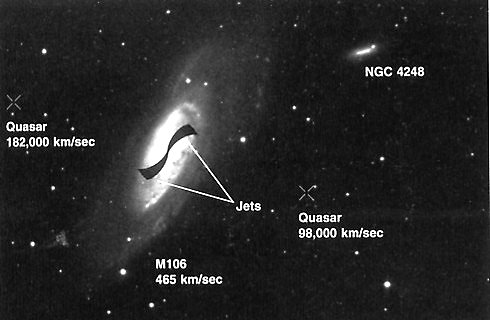
The active center also emits jets, as was described by Brent Tully, Jon Morse, and Patrick Shopbell in Sky & Telescope, Nov 1995 (p 20). This makes it similar to the central "engines" in other active galaxies. See the Diagram below from that article:
Have these 2 quasars been ejected from NGC 4258 by some mechanism?
Still more mind boggling, in 1995 E. Margaret Burbidge of the University of California San Diego, theorized that X-Ray data along with spectrums from Lick Observatory suggested that 2 nearby objects (previously identified as quasars some 9 arc minutes from the galaxy core) with very high redshifts were ejected from NGC 4258. While “jets” have been observed in the spectrum and at radio wavelengths in the 1960’s and 70’s, none have been detected optically. In 1994, Pietsch et al. used observations from the X-Ray satellite ROSAT and detected X-Ray contours extended from the spiral arms touching each of the symmetrically placed quasars. If the connection between the galaxy and the quasars is real, this could be convincing evidence that some quasars are indeed ejected from galaxies and could be a major breakdown in the theory for their acceptance at cosmological distances. In Halton Arp’s 1987 Book, “Quasars, Redshifts and Controversies” pages 153-154, he proposed that the then known radio jets extending out from NGC 4258 were the result of some kind of ejection phenomena, causing the birth of new spiral arms. Needless to say, this interpretation has made a serious impact on theories of galaxy evolution and dynamics.
A supernova (1981K) occurred in M106 in August 1981 and reached 16th magnitude.

Finder chart for NGC 4258.
REFERENCES
Burbidge, E.M., 1995, Spectra of Two Quasars Possibly Ejected from NGC 4258, Astronomy & Astrophysics Letters, 298, L1-L4
Pietsch, W., Vogler, A., Kahabka, P., Jain, A., Klein, U., 1994, ROSAT PSPC X-Ray Observations of NGC 4258: Detection of Point Sources, 4 Million K Halo Emission, and Anomalous Arms, Astronomy & Astrophysics, 284, p. 386-402
Sky and Telescope, 1995, Quasars Ejected from M106?, November 1995, p. 15-16